The 7.0.2 security release addresses one critical and one high severity security issue.
Because this is a security release, it is recommended that you update your sites immediately. Due to the severity, the WordPress.org team have enabled forced updates via the auto-update system for sites running affected versions.
To manually update you can visit your WordPress Dashboard, click “Updates”, and then click “Update Now”, or you can download WordPress 7.0.2 from WordPress.org. On sites that support automatic background updates, the update process will begin automatically.
Security updates included in this release
The security team would like to thank the following people for responsibly reporting vulnerabilities and allowing them to be fixed in this release:
A facilitated SQL injection issue reported as a team by TF1T, dtro, and haongo
A REST API batch-route confusion and SQL injection issue leading to Remote Code Execution reported by Adam Kues at Assetnote / Searchlight Cyber
For more information on this release, please visit the HelpHub site.
Backports
WordPress 6.9 is affected by both vulnerabilities. Version 6.9.5 has been released containing fixes for both.
WordPress 6.8 is only affected by the first vulnerability. Version 6.8.6 has been released containing a fix.
The beta release of WordPress 7.1 is affected by both vulnerabilities. Version 7.1 beta2 has been released containing fixes for both.
Versions of WordPress prior to 6.8 are not affected.
If you run a WordPress site, then you know that spam is a real annoying problem whether it comes to contact forms, WordPress comments, or user registrations.
The good news is that stopping spam in WordPress is a lot easier than you probably think, and you don’t need expensive tools either.
We have spent over 16 years testing anti-spam plugins, tools, and refining strategies to keep WPBeginner and our other business websites safe from daily spam attacks.
In this ultimate guide, we’ll walk you through how to block each type of WordPress spam, step by step from the basics to advanced modern automated spam protection. These are the exact methods we’re using to protect our own websites.
We’re covering a lot of ground in this ultimate guide, so use the quick links below to jump straight to the section you want to learn about first:
WordPress comes with several anti-spam options that can protect your site against spam. These built-in options won’t stop every bot, but they will remove the easiest targets right away.
We always recommend turning these settings on first, because they cost nothing and take only a few minutes to set up.
Tighten Your WordPress Discussion Settings
To prevent comment spam, the built-in discussion settings in WordPress act as your first line of defense. They allow you to control who can post, what kind of links are permitted, and how much control you have over the conversation.
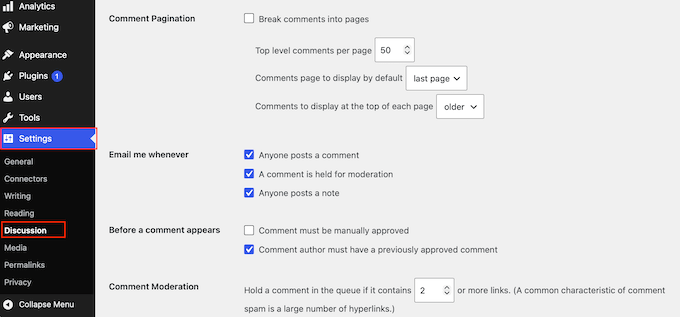
To configure these anti-spam controls, go to Settings » Discussion in your WordPress dashboard.
The most useful tool on this screen is the comment moderation queue. This tool acts as a holding area that keeps submissions hidden from the public until you have a chance to look them over.
Because nothing goes live automatically, spam never reaches your visitors, even if it manages to get past your other filters.
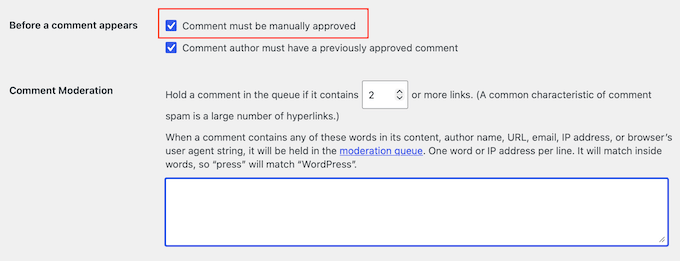
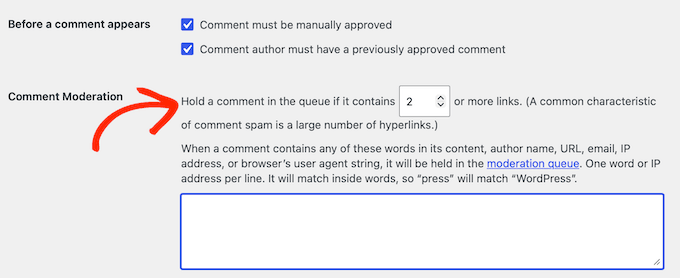
To turn this on, scroll down to the ‘Before a comment appears’ section and check the box next to ‘Comment must be manually approved.’
If you want, you can also enable ‘Comment author must have a previously approved comment.’ This lets returning commenters post without waiting for approval. However, be sure to review your published comments regularly since they won’t appear in your moderation queue.
After that, scroll to the ‘Comment Moderation’ box, where you’ll find a setting that limits links. Because spam comments almost always contain web addresses, WordPress can automatically hold any submission that includes too many links.
The field labeled ‘Hold a comment in the queue if it contains [X] or more links’ is set to 2 by default. Lowering that number to 1 will help you catch even more junk.
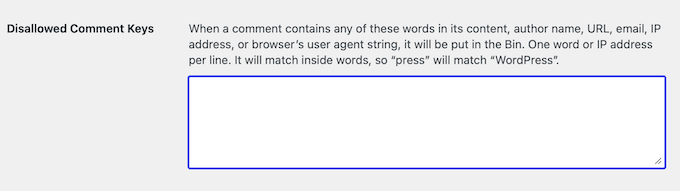
On the same screen, you can use the comment blocklist to automatically filter out unwanted content. This tool looks for specific words, names, email addresses, or web addresses and sends any matching comment straight to the trash.
In the ‘Disallowed Comment Keys’ box, you can paste your own trigger words, putting one on each line, and then save your changes.
Require a Name and Email, and Hold First-Time Commenters
Healthy discussions start with real people. Requiring commenters to enter a name and email encourages more thoughtful conversations and discourages anonymous drive-by comments.
Most genuine visitors won’t mind providing these details, and it helps create a more welcoming and trustworthy community around your website.
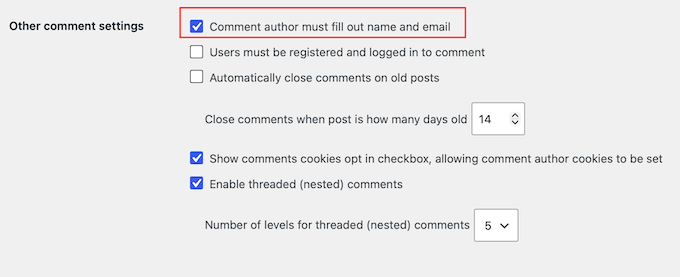
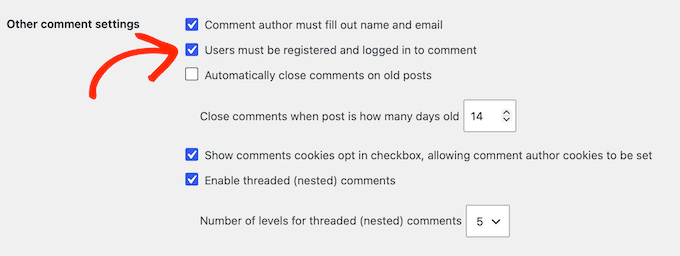
To enable this, scroll to the ‘Other comment settings’ section and check the box next to ‘Comment author must fill out name and email.’
Depending on the type of website you have, you may not need a comment section at all. If that’s the case, then you can simply disable comments entirely and that’ll get rid of the WordPress comment spam problem once and for all.
The most thorough option is the code method, which disables comment support across your entire site at once. It’s safest to add the snippet with a free code snippets plugin like WPCode rather than editing your theme’s files directly, so a theme update can’t undo it.
add_action('admin_init', function () {
    // Redirect any user trying to access comments page
    global $pagenow;

    if ($pagenow === 'edit-comments.php') {
        wp_safe_redirect(admin_url());
        exit;
    }

    // Remove comments metabox from dashboard
    remove_meta_box('dashboard_recent_comments', 'dashboard', 'normal');

    // Disable support for comments and trackbacks in post types
    foreach (get_post_types() as $post_type) {
        if (post_type_supports($post_type, 'comments')) {
            remove_post_type_support($post_type, 'comments');
            remove_post_type_support($post_type, 'trackbacks');
        }
    }
});

// Close comments on the front-end
add_filter('comments_open', '__return_false', 20, 2);
add_filter('pings_open', '__return_false', 20, 2);

// Hide existing comments
add_filter('comments_array', '__return_empty_array', 10, 2);

// Remove comments page in menu
add_action('admin_menu', function () {
    remove_menu_page('edit-comments.php');
});

// Remove comments links from admin bar
add_action('init', function () {
    if (is_admin_bar_showing()) {
        remove_action('admin_bar_menu', 'wp_admin_bar_comments_menu', 60);
    }
});
If you’d rather not go site-wide, you can also turn comments off on individual pages. This is handy when you only want them gone on specific pages, like your Contact or About pages, which rarely need a comment section.
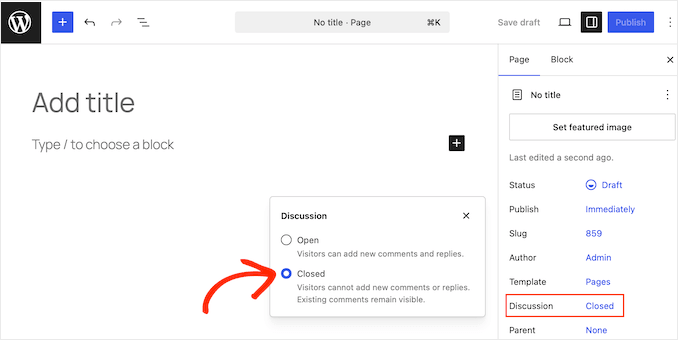
To do this, open the page in the WordPress content editor. Then click the ‘Discussion’ option in the right-hand sidebar and select ‘Closed.’
You can also stop spam from piling up on older content without touching your newer posts. If you don’t expect comments on old posts, then WordPress can close them automatically after a set number of days.
This gives spam bots fewer chances to target your archived content.
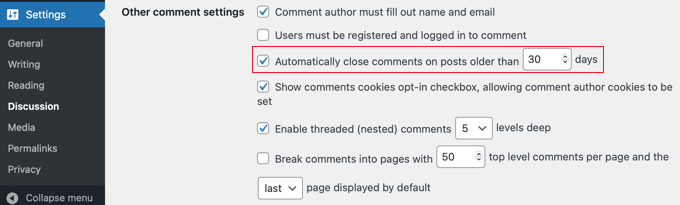
To set this up, head to Settings » Discussion and find the ‘Other comment settings’ section. Check the box next to ‘Automatically close comments on posts older than [X] days’, then set a sensible limit such as 30 or 90 days.
Disable Trackbacks and Pingbacks
Trackbacks and pingbacks notify you when another website claims to have linked to one of your blog posts.
While they were originally designed to help bloggers connect conversations across different websites, they’re now commonly abused by spammers to send fake link notifications.
Turning this feature off completely removes a whole category of junk notifications from your dashboard.
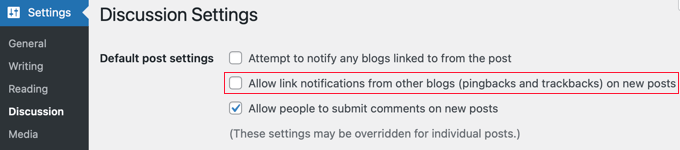
To disable these notifications, go to the Settings » Discussion screen in your WordPress dashboard. Here, uncheck the box next to ‘Allow link notifications from other blogs (pingbacks and trackbacks) on new posts.’
With that done, don’t forget to click ‘Save Changes’ at the bottom of the screen.
Just be aware that changing this option only protects the posts you publish from this moment forward. If you want to clean up the content you’ve already published in the past, you can follow our step-by-step guide on how to disable trackbacks and pings on existing WordPress posts.
2. Set Up Modern AI-Powered Spam Bot Protection for WordPress
In the era of AI where automated spam is increasing, the best defense against it is a modern AI-powered spam protection for WordPress.
These spam filtering solutions automatically detect and block spam on your WordPress comments, contact forms, and user registrations without the use of CAPTCHA which can hurt conversions.
On WPBeginner, we use ActiveLayer for this. It is AI-powered and runs server-side, so it stops spam invisibly, without a CAPTCHA and it’s GDPR compliant.
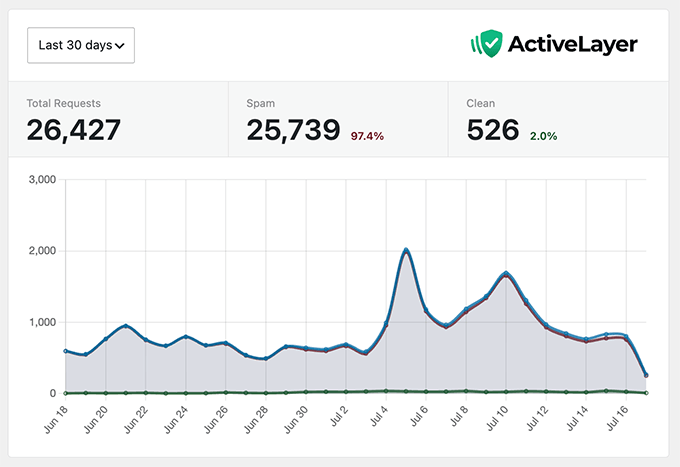
In the last 30 days, it has blocked over 25,739 spam comments and contact form submissions on our website. It even shows you a confidence score, and the reason behind every submission it flags, not just a pass-or-fail verdict when you look at their logs.
The free plan includes 1,000 spam checks with no credit card, and paid plans start at around $4 per month billed yearly.
The two other popular spam filtering plugins for WordPress you could try are Akismet or CleanTalk.
Akismet is very popular and still is a good fit for personal blogs, where its “name your price” plan can be free for non-commercial sites. But they have raised their prices significantly for commercial sites which is quite expensive for smaller businesses. For a business site, we would point you to either ActiveLayer or CleanTalk.
Whichever tool you choose, stick to just one, because running two spam filters at once can conflict and block real visitors. The benefit of these spam protection plugins are that they integrate with all other popular contact form plugins by default.
3. Power-User Tips for Stopping WordPress Comment Spam
So far we’ve configured the built-in spam prevention settings in WordPress, and an automated spam filtering plugin for WordPress. The combination of these two should block most spam.
However if you are not able to set up modern AI spam protection due to costs or another reason, then you can use one of these tips below to combat comment spam in WordPress.
Add a Free CAPTCHA to Your Comment Form
CAPTCHA is a simple test that most human visitors pass without any effort, while automated scripts fail it. We recommend adding Cloudflare Turnstile CAPTCHA to your WordPress comments because it’s free and fairly straight forward to set up.
To set it up, install and activate the free Simple Cloudflare Turnstile plugin. You will be asked to create a free account on Cloudflare’s website and connect it with the plugin.
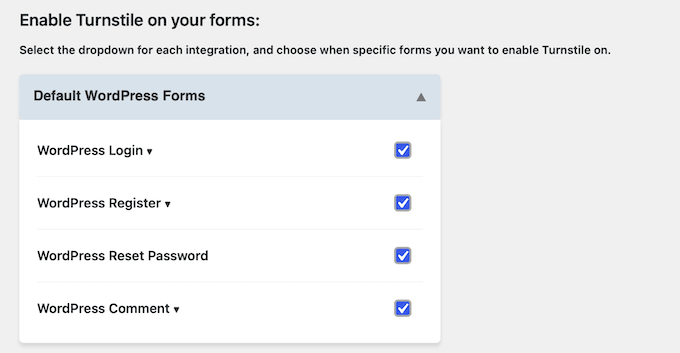
Once that’s done, you can scroll to the ‘Enable Turnstile on your forms’ section. Simply check the boxes to protect all your WordPress forms and click ‘Save Changes’.
Google reCAPTCHA is another option, which you can add with the Advanced Google reCAPTCHA plugin. We no longer recommend it because Google has capped their free tier at 10,000 assessments per month for your entire organization whereas Cloudflare Turnstile stay free without limits.
Limit or Require Login to Comment
Another really effective way to stop comment spam in WordPress is to control who’s allowed to participate in comments.
If your comment section is open to everyone, then spammers can continuously flood your forms with automated links. Restricting comments to registered account holders ensures that only verified users can post. This forces a level of accountability that most bots will not bother trying to bypass.
Because it requires readers to go through the extra step of creating and logging into an account, this approach is best suited for membership sites, online forums, and private communities.
If you run an open, public blog, then we’d recommend using an automated filtering service or a reader challenge instead as those add less friction.
If you do decide to turn this restriction on, go to Settings » Discussion in your WordPress dashboard. Under the ‘Other comment settings’ section, check the box next to ‘Users must be registered and logged in to comment.’
As always, don’t forget to save your changes.
Use Antispam Bee for Free Keyword and Pattern Filtering
Some spam slips through basic checks by mimicking human writing. This is where a dedicated filtering plugin can help protect your site.
Antispam Bee is an excellent free, privacy-friendly anti-spam plugin that doesn’t require an API key or account registration. Installing Antispam Bee gives you a powerful set of local rules to analyze comment data before it even hits your database.
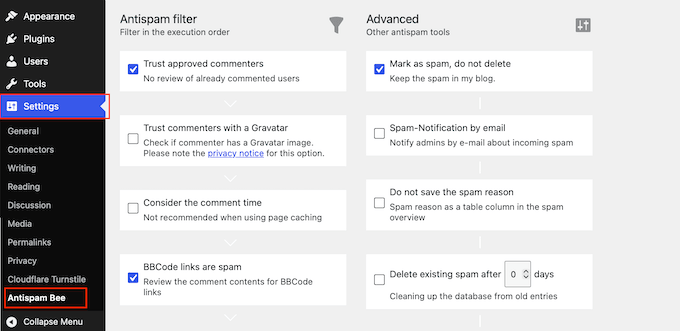
Once it’s activated, you can configure your rules by going to Settings » Antispam Bee.
We recommend enabling the options to:
Trust approved commenters.
Mark as spam.
Do not delete.
Use regular expressions (which allows the plugin to scan for known text and link patterns).
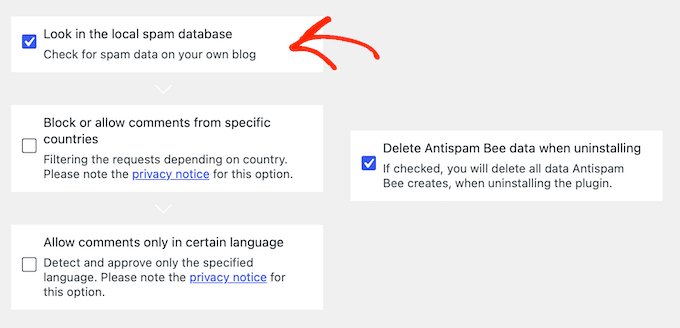
You should also check the box to ‘Look in the local spam database.’ This allows Antispam Bee to cross-reference new submissions against previous spam history on your site.
Under ‘Advanced,’ you can set Antispam Bee to delete existing spam after a set number of days, which keeps your database tidy without any manual effort.
We highly recommend leaving the email notifications for spam turned off in this section. A busy website can attract hundreds of automated submissions a day, and these alerts will quickly flood your inbox.
If you want to try one more free tweak, then you can remove the website address field from the comment form.
4. Stopping WordPress Contact Form Spam (Best Practices)
Contact and lead forms are among the most attacked parts of any WordPress site. We know this firsthand because we once had to combat more than 18,000 spam entries flooding a single form.
We use WPForms to build forms on WPBeginner, and it’s a popular form builder plugin used by over 5 million websites. Their free version includes smart anti-spam protection, CAPTCHA integrations with Google / Cloudflare Turnstile, and the paid plans add the filtering options we cover below.
Other popular form builders like Gravity Forms and Fluent Forms have similar anti-spam settings, so check the options in whichever form builder plugin you use. We will show WPForms here because it’s what we use and consider the best fit for beginners.
Enable Default Anti-Spam Token (or Similar HoneyPot)
To combat lead form spam, WPForms silently attaches a unique, time-sensitive token to your form on every page load. The anti-spam token blocks automated scripts, which means spam entries are blocked before they reach your inbox.
It’s turned on by default for new forms, but it’s worth confirming.
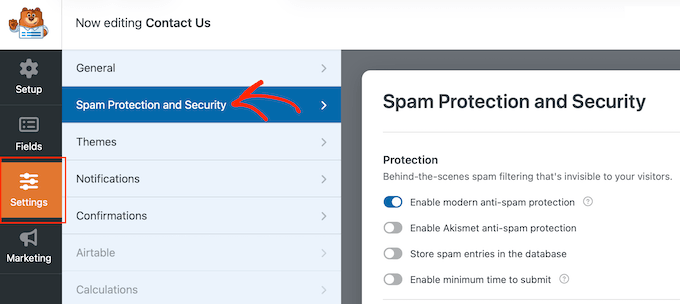
Open your form, go to Settings » Spam Protection and Security, and make sure ‘Enable modern anti-spam protection’ is switched on.
This is a modern version of the Honeypot technology which most WordPress form plugins come with, so it may be labeled as Honeypot in another form tool that you might be using.
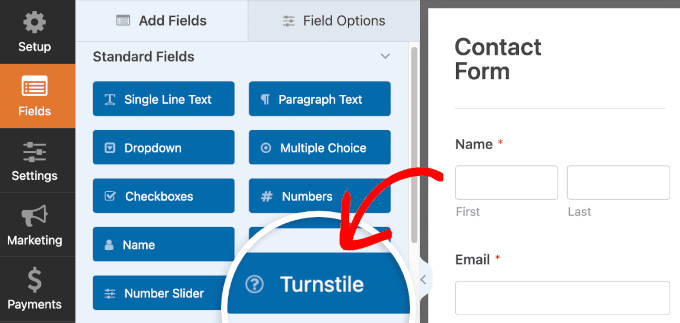
Enable a CAPTCHA on Your Contact Form
More aggressive bots mimic human browsing and slip past the invisible token. Adding a visible CAPTCHA field stops them by forcing a challenge they can’t read or solve.
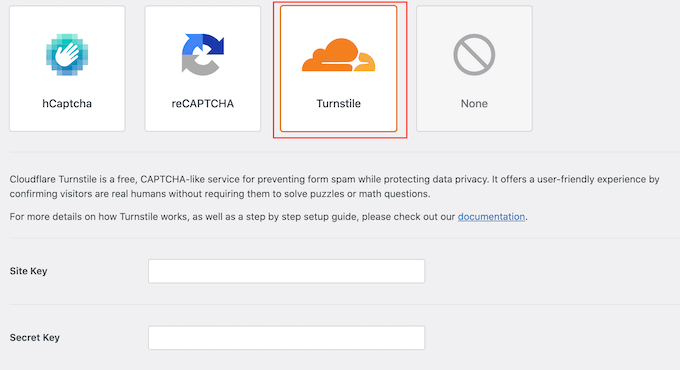
WPForms has both Cloudflare Turnstile and Google reCAPTCHA built in, and we default to Turnstile here. It’s free for everyone and runs its checks in the background, so most real visitors pass without solving a puzzle.
To set it up, go to WPForms » Settings » CAPTCHA and choose ‘Cloudflare Turnstile’.
Google reCAPTCHA is also selectable on that same WPForms » Settings » CAPTCHA screen. We default to Turnstile because it’s free without limits, but reCAPTCHA still works if you prefer it.
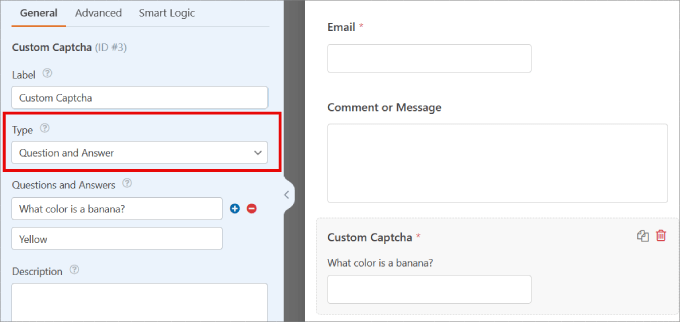
If you’d rather not send visitor data to Google or Cloudflare, then WPForms’ Custom Captcha field (available on any paid plan) builds the challenge on your own server instead.
Add the field, then set it to a random math problem or your own question and answer.
Use Time-Based Behavioral Checks to Stop Contact Form Spam
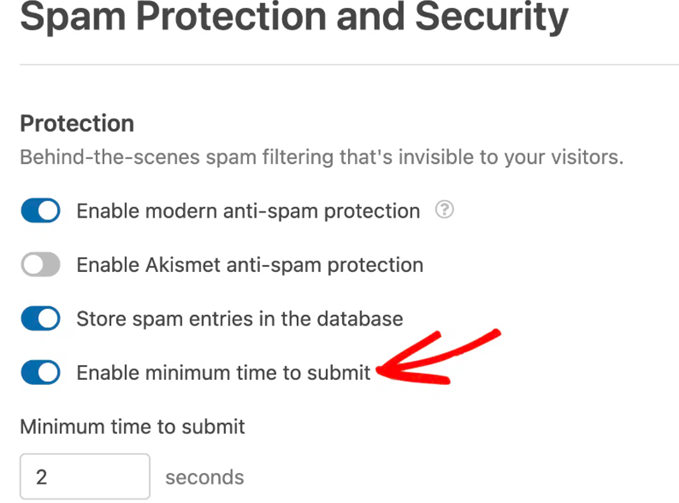
A real person needs several seconds to read a question and fill out a form, while a bot submits in a fraction of a second. Time-based checks flag those impossibly fast submissions without changing anything the visitor sees.
With WPForms, the ‘Enable minimum time to submit’ option is enabled by default with a minimum time to submit of 2 seconds. However, you can update the minimum time to any value you like.
Block Form Submission by Country, IP, Email Address, and More
Some spam form submissions still gets through unless you screen the content itself. In the Pro version, WPForms lets you block entries by specific email address, by keyword, and by country or IP address.
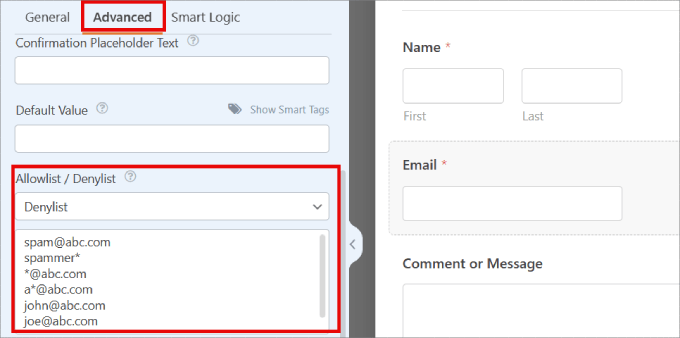
To block a sender, open your form, select the Email field, open the Advanced tab, choose Denylist, and enter the addresses or domains to ban. A wildcard like *@example.com blocks an entire domain.
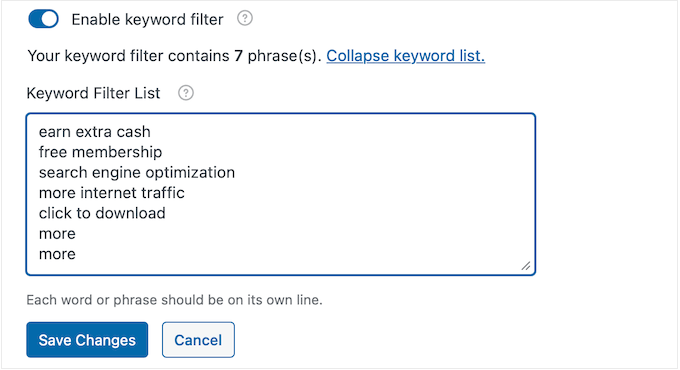
To block spammy phrases, go to Settings » Spam Protection and Security.
Turn on ‘Enable keyword filter’, open ‘Edit keyword list’, and add each term on its own line.
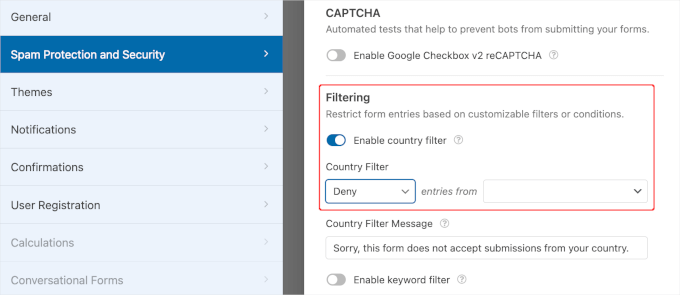
And if you only serve certain regions, turn on ‘Enable country filter’ on the same screen to allow or deny locations.
5. Stopping Spam User Registrations in WordPress (Best Practices)
On a membership site or WooCommerce store, spam registrations are more than a nuisance. Fake accounts clog your user database and skew your customer and email metrics.
Here’s what you can do to prevent spam user registrations in WordPress.
Turn Registration Off When You Do Not Need It
If you’re not running a membership site or an eCommerce store, then you likely don’t need to allow user registration. The easiest thing to prevent user registration spam there is to turn it off.
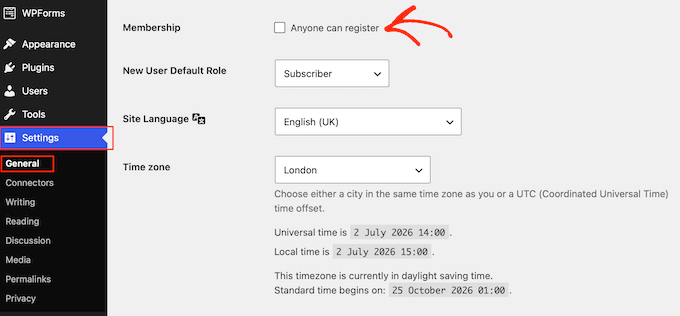
Simply go to Settings » General in your WordPress admin area, and uncheck the ‘Anyone can register’ box.
Require Email Confirmation Before an Account Activates
If you do need open registration, then the goal is to let only real people in while keeping spam bots out. The setting that stops the most fake signups is requiring a confirmed email address, or a manual review, before an account goes live.
Where that control lives depends on what plugin you’re using to manage user registration in WordPress. You will want to start with your platform’s default setting instead of bolting a general form plugin onto a system that already handles this.
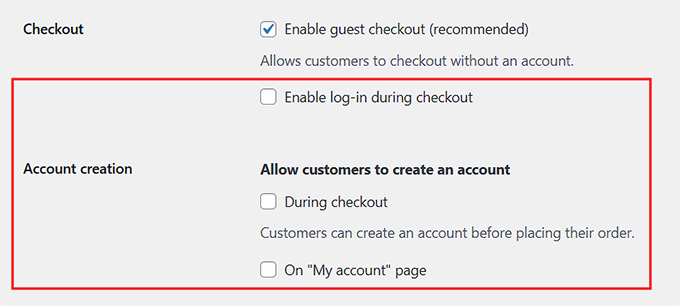
If you run a WooCommerce store, then go to WooCommerce » Settings » Accounts & Privacy. This is where you decide whether shoppers can create an account at all, limit account creation to checkout, or keep guest checkout on so no account creation is needed.
WooCommerce core doesn’t add a separate email-confirmation step on its own. If you want one, then you’ll need a custom email verification extension or the custom signup form covered below.
Other membership and course platforms handle account verification in their own settings, so start there:
BuddyPress and BuddyBoss: email activation is built in, so new members stay inactive until they click the activation link. Enable registration under Settings » General (BuddyPress) or BuddyBoss » Settings » Login & Registration. See BuddyPress documentation and BuddyBoss documentation for more details.
LearnDash: registration runs on WordPress’s own user system, so there’s no native email-confirmation step. An account goes live the moment someone signs up. To hold new accounts until the email is verified, add that check at the WordPress or form level, using a user verification plugin or the custom WPForms registration form covered below.
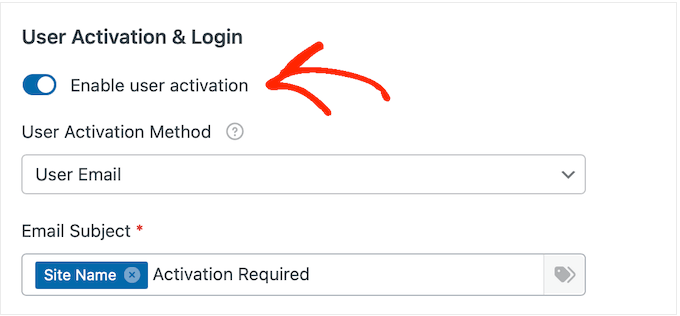
If you’re building a custom registration form rather than using one of the systems above, then you can use WPForms User Registration addon which lets you turn on email activation under the form’s User Registration settings, with either an email confirmation link or manual admin approval.
Similar options are available in Gravity Forms, WSForm, and other popular WordPress form plugins. For the full walkthrough, see our guide on how to moderate new user registrations.
Add CAPTCHA and Honeypot to WordPress Signup Form
The same tips that protect your WordPress contact forms also work on WordPress signup form. Since you already set up Cloudflare Turnstile earlier, you can switch it on for your registration form in a click.
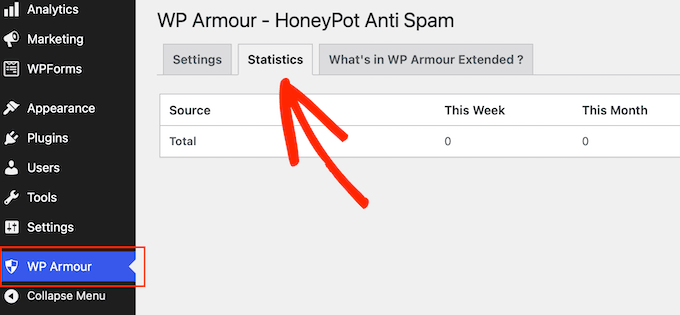
If you’re using the default WordPress registration page, then you can add hidden honeypot fields to your registration form with the free WP Armour plugin. The plugin logs every bot it blocks under WP Armour » Statistics.
Use AI-Powered Tools for Blocking WordPress Registration Spam
Honeypots and CAPTCHAs stop obvious bots, but they can’t spot someone signing up with a throwaway email or from a known-bad IP address.
That’s where automated detection helps. It screens each new signup against live reputation data and blocks the ones that look fraudulent.
ActiveLayer and CleanTalk both offer this for WordPress registrations, and you can switch it on for your signup form the same way you did for your contact forms.
6. Add a Site-Wide WordPress Firewall
A Web Application Firewall (WAF) screens every visitor and blocks malicious requests before they reach your site. Since most form spam is automated, a good firewall can stop a lot of it at the perimeter.
We recommend a DNS-level firewall, which filters traffic on the provider’s network before it touches your server.
On WPBeginner, we use Cloudflare, which has a free plan with basic firewall protection (setup requires pointing your domain’s nameservers to Cloudflare).
Stopping new spam is only half the job. If you’re like most websites, you already have a backlog of old junk that needs cleaning up.
A quick cleanup keeps your database tidy and helps your new tools run at their best.
🚨 Always create a complete WordPress backup before deleting anything in bulk. These actions permanently wipe data, with no undo button if you make a mistake.
Bulk-Delete Existing Spam Comments
WordPress spam filter flags junk comments but doesn’t delete them, so they can build up in your spam folder and take up database space until you clear them out.
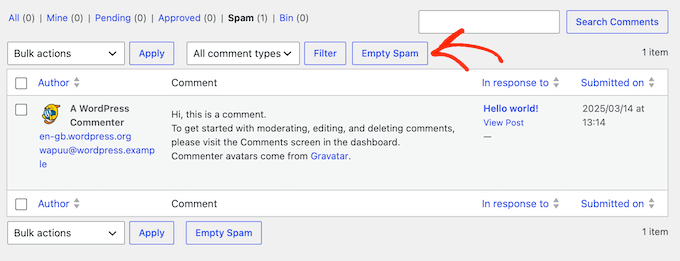
In your dashboard, go to Comments, click the ‘Spam’ filter at the top, and hit ‘Empty Spam’ to permanently clear everything your filters caught.
If you have thousands of junk comments, the dashboard can freeze or time out. A free plugin like WP Bulk Delete is faster and more reliable for big backlogs.
Leaving bot profiles in your database is a security risk and skews your analytics. That’s why it’s important to clean out these fake accounts.
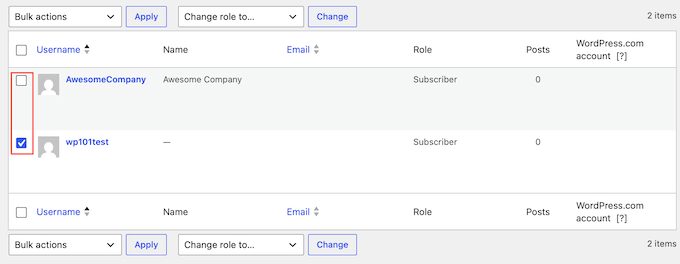
For a handful, go to Users » All Users, click the ‘Subscriber’ user role filter (the role almost all registration bots use), select the fake accounts, and choose Delete from the ‘Bulk actions’ menu.
⚠️ Be very careful to select only fake Subscriber accounts, and never an Administrator account.
For thousands of accounts, the free WP Bulk Delete plugin can remove users by role, inactivity, or registration date in one sweep.
No filter is perfect, so never auto-delete your spam folder without a quick glance first.
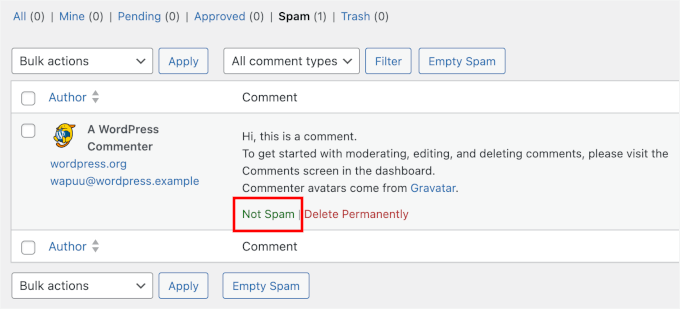
In Comments » Spam, hover over a legitimate comment and click ‘Not Spam’. That also teaches your filter to recognize similar comments as safe in the future.
Set a Monthly Anti-Spam Review Routine
A few minutes each month keeps spam from piling back up. Add these three checks to your maintenance routine:
Scan for false positives: skim your spam comment folder and form entries so no real messages were caught by accident.
Empty your spam folders: once you’ve rescued anything real, clear them to keep your database lean.
Check your user list: glance at new registrations for gibberish usernames or suspicious email domains that slipped through.
Key Takeaways
Here is a summary of the best practices we have covered to completely protect your WordPress website from spam:
Start with free WordPress settings: turn on comment moderation, tighten your link limits, build a comment blocklist, and disable trackbacks. These cost nothing and clear out the easiest spam.
Use automated, invisible filtering: a server-side tool like ActiveLayer, Akismet, or CleanTalk blocks bots in the background without making real visitors solve puzzles.
Layer your contact form defenses: honeypots alone no longer stop modern bots, so combine them with timing checks, token validation, and an automated filter.
Secure your registrations: require email confirmation for new accounts and screen every signup with an automated tool.
Add a site-wide firewall: a DNS-level firewall like Cloudflare blocks a lot of automated spam at the perimeter, before it ever reaches your forms.
Run regular cleanup: bulk-delete old spam comments and fake accounts, then spend a few minutes each month checking for false positives.
Frequently Asked Questions About WordPress Spam Protection
Is free Akismet-style filtering enough, or do I need
more?
For a small personal blog with only comment spam, a single free filter like Akismet is usually enough. Once you add contact forms, signup forms, or user registration, you’ll want a service that protects those too, like ActiveLayer or CleanTalk.
Will adding a CAPTCHA hurt my form conversions?
It can. The extra step causes some real visitors to give up on the form. This is why we prefer invisible, server-side detection that blocks bots without asking anyone to solve a puzzle.
Why am I still getting spam after installing an anti-spam
plugin?
Usually because the plugin only guards one entry point. If it protects your
comments but not your signup or contact forms, bots just move to those
instead, and older tricks like basic honeypots no longer stop modern bots. The
fix is a layered setup: your built-in WordPress settings, an automated
filter, and a firewall working together.
How do I stop fake user registrations without turning off signups
completely?
Turn on email confirmation so new accounts stay inactive until the person
clicks a link in their inbox, which bots can’t do. Pair it with a honeypot and
an automated filter, and real people can still sign up freely.
Can spam actually hurt my SEO or get my site
blacklisted?
It can, but it depends on where the spam is. Comment spam sitting in your moderation queue is never published, so search engines never see it and your SEO stays safe.
Published spam is the real risk, because it can slowly pull down your rankings. WordPress does tag comment links as nofollow, which limits the damage.
We hope this article helped you learn how to protect your WordPress website against spam. You may also want to check out our ultimate WordPress security guide to improve your website security.
If you liked this article, then please subscribe to our YouTube Channel for WordPress video tutorials. You can also find us on Twitter and Facebook.
For years, the post editor has lived a double life. The Site Editor renders your blocks inside an iframe. The post editor — where most people actually spend their time — renders them directly in the admin page. That split ends with WordPress 7.1: the post editor canvas will always be an iframe, on every theme, no matter what apiVersion your blocks declare. The Gutenberg plugin has been enforcing exactly this for months. If you ship blocks, assume the iframe.
If your block never touches the global document or window, you can probably stop reading after you’ve changed "apiVersion": 2 to "apiVersion": 3 in block.json. For everyone else — and especially anyone shipping blocks that wrap third-party libraries — the iframe changes where your code runs versus where your markup lives. That gap is where things break.
Console warning (with SCRIPT_DEBUG) when a block registers with apiVersion 2 or lower. The block.json schema now only validates apiVersion: 3.
WordPress 7.0 (Apr 2026)
The iframe decision now looks at blocks actually inserted in the post, not every registered block. All inserted blocks on v3+ → canvas is iframed. Insert a single v1/v2 block → the iframe is removed on the fly. Nothing is enforced yet.
Gutenberg 22.6+
The iframe is enforced regardless of theme — this is the feedback-gathering phase.
WordPress 7.1 (Aug 19, 2026)
The iframe is enforced on every theme, regardless of apiVersion. The conditions are gone, not tightened.
The WordPress 7.0 change is subtle but important: before 7.0, one apiVersion: 2 block registered by any active plugin — even one never used in the post — kept the entire editor out of the iframe for everyone. Now only inserted blocks count. Your v3 block gets the iframe until the user inserts a legacy one, at which point the editor quietly reloads the canvas without the iframe. The companion plugin ships a legacy-api-v2 block so you can watch this happen — insert it into an otherwise-v3 post and the iframe disappears. In 7.1, that escape hatch closes.
Worth knowing, as an aside: the “every theme” decision landed in WordPress 7.1 Beta 1, and it’s deliberately being tested in public. Gutenberg merged “Post editor: always iframe” (#74042) on July 10, 2026, deleting the theme and apiVersion conditions outright. The 7.1 release lead signed off on that merge on the condition that the team could “move to the softer approach” if Beta 1 feedback surfaced real problems — the softer approach being enforcement on block themes only, with everything else staying on the 7.0 rules. No specific mechanism is committed to; the plan is to respond to what the beta actually turns up. Which is a reason to test harder, not to wait and see. If that rollback happens, the iframed and non-iframed editors both stay in the wild longer — and your block has to work in both regardless of which way it goes.
It’s also worth noting that blocks that will break with the 7.1 changes are most likely already breaking in the Site Editor.
Why the iframe is a good thing
This isn’t change for change sake. Rendering the canvas in an iframe gives the editor a real document boundary:
Admin CSS stops leaking into your content. No more #wpadminbar-adjacent style resets, no more admin styles subtly changing how blocks render in the editor versus the front end.
Viewport units and media queries finally work.vw, vh, and @media rules resolve against the canvas, not the admin page — so tablet/mobile previews and zoomed-out views actually behave like the front end.
What you see is much closer to what you get. The canvas document is built from your theme’s styles, not the admin’s.
The issue this raises for block developers? Your editor JavaScript runs in the admin page, but your block’s DOM lives in a different document. Every assumption baked into document.querySelector(...) and window.addEventListener(...) just became wrong.
What actually breaks (and how to fix it)
Everything below is demonstrable with the companion plugin — each pattern ships as a broken/fixed pair of blocks: iframe-editor-examples on GitHub.
1. Global window and document references
The classic: a block that reads the viewport or listens for resize.
Editor scripts load in the admin page, so window is the admin window. In the iframed editor this reports the wrong width and never reacts to the canvas resizing — switch to the Tablet preview and the number doesn’t move.
The fix is to derive the document and window from your block’s own DOM element:
element.ownerDocument is whatever document the block is rendered into — the iframe’s document when iframed, the admin document when not. ownerDocument.defaultView is that document’s window. Code written this way is context-agnostic: it doesn’t care whether the iframe exists.
useRefEffect (from @wordpress/compose) instead of useRef + useEffect: it re-runs the callback when the ref changes, so if the block ever moves between documents, your listeners re-attach to the right window.
2. “Close on outside click” and other document-level events
This one is my favorite because it fails weirdly. A dropdown that closes when you click outside, implemented the way every React tutorial teaches it:
In the iframed editor, clicks inside the canvas happen in the iframe’s document. They never bubble to the admin document, so the listener never fires. The result: click another block in the canvas and the dropdown stays open — but click the admin sidebar and it closes. Same code, same block, works perfectly in the non-iframed editor. This is the kind of bug report you’ll get from users that “can’t be reproduced” — because whoever tested it happened to have a v2 block sitting in their post, which quietly dropped the iframe and made everything work.
If you’re styling your block’s editor experience with enqueue_block_editor_assets, those styles load in the admin page — outside the iframe. They silently stop applying the moment the canvas is iframed:
PHP
// ❌ Loads in the admin page — never reaches the iframed canvas.functionmyplugin_enqueue_editor_styles() {wp_enqueue_style( 'myplugin-editor', plugins_url( 'editor.css', __FILE__ ) );}add_action( 'enqueue_block_editor_assets', 'myplugin_enqueue_editor_styles' );
The fix is to register editor styles through block.json, which WordPress injects into the canvas document, iframed or not:
JSON
{"editorStyle": "file:./index.css"}
(add_editor_style() also gets copied into the iframe, if you need theme-level editor styles.)
The demo plugin makes this visual: the same block carries a green banner from editorStyle and a red banner from enqueue_block_editor_assets. Count the banners — two means no iframe, one means you’re iframed.
4. Stale CSS written for the leaky editor
The section above is about CSS loading into the wrong document. This one is the sneakier inverse: the stylesheet loads into the right document — injected straight into the canvas, exactly as intended — and still gets it wrong, because of what it was written to describe. These are the rules that quietly stop matching, or start over-matching, once the canvas becomes its own document. It’s the code that’s been sitting in themes and plugins for years, “working,” right up until the iframe is enforced.
Selectors keyed on admin body classes
The most common one, and it fails exactly like the “close on outside click” bug — silently.
CSS
/* ❌ The canvas body no longer carries these classes */.wp-admin.my-block { padding: 2rem; }body.block-editor-page.my-block__title { font-size: 2rem; }
Inside the iframe, the canvas <body> is a clean document — no wp-admin, no block-editor-page. The selector matches nothing and your editor styling just evaporates. Same block, same stylesheet, works perfectly in the non-iframed editor.
CSS
/* ✅ Scope to the block, not the admin chrome */.my-block { padding: 2rem; }.my-block__title { font-size: 2rem; }
.editor-styles-wrapperdoes still wrap the canvas content inside the iframe, so .editor-styles-wrapper .my-block keeps working if you need genuinely editor-only styling — but the admin ancestor was almost never necessary in the first place.
Offsets that compensate for admin chrome
CSS
/* ❌ Subtracting the admin sidebar and adminbar from the viewport */.my-fullwidth { width: calc( 100vw - 160px ); } /* 160px = admin menu */.my-toolbar { position: fixed; top: 32px; } /* 32px = #wpadminbar */
This is the flip side of the win from earlier: now that 100vw resolves against the canvas instead of the admin page, there’s no sidebar to subtract — so the calc() overshoots, and top: 32px pushes your toolbar below an admin bar that doesn’t exist in this document.
CSS
/* ✅ The canvas is the viewport now — no compensation needed */.my-fullwidth { width: 100vw; }.my-toolbar { position: fixed; top: 0; }
Specificity walls built to fight leakage
CSS
/* ❌ Cranked up to beat leaking admin styles */.editor-styles-wrapper.my-blockp {font-family: Georgia, serif!important;line-height: 1.6!important;box-sizing: border-box!important;}
The iframe already stops admin CSS from leaking in — that’s one of the reasons it’s a good thing. These !importants and resets have no admin styles left to override, but they do now override the theme styles the iframe loads into the canvas. The result: your editor preview drifts away from the front end — the exact opposite of what the iframe is for.
CSS
/* ✅ Let theme styles through; set only what your block truly owns */.my-blockp { font-family: Georgia, serif; }
Two things to notice:
The pattern is the same as the JavaScript fixes: stop describing the admin, start describing your block. A selector that names .wp-admin, #wpadminbar, or .block-editor-page is reaching for chrome that isn’t in the canvas document anymore.
Most of these were workarounds for problems the iframe solves. Deleting them is usually the fix.
5. Third-party libraries that assume one global context
The biggest real-world hazard. Masonry layouts, sliders, lightboxes, maps — a generation of libraries was written assuming there is exactly one document:
JavaScript
// Inside some-legacy-lib.jsconsttargets = document.querySelectorAll( selector ); // finds nothing in the iframe
Your block calls the library, the library queries the admin document, finds zero matches, and silently does nothing. No error, no warning — the block just stops being enhanced.
Your options, in order of preference:
Pass elements, not selectors. If the library accepts an element (lib.init( element )), hand it the block’s element from useRefEffect and you’re usually fine.
Patch the library. For unmaintained dependencies, patch-package is the pragmatic answer: edit the module in node_modules to resolve document/window from the element (node.ownerDocument), run npx patch-package <pkg>, commit the patch, add a postinstall script. The official migration guide walks through a real patch for @panzoom/panzoom.
Guard and bail. If the library is loaded inside the iframe (front-end scripts are), check for it on defaultView before using it: if ( ! defaultView.jQuery ) return;
So what does apiVersion: 3 actually do?
Less than you might think — and that’s the point. Declaring "apiVersion": 3 in block.json doesn’t change how your block renders; it’s a signal that your block is iframe-ready. All core blocks have been on v3 since WordPress 6.3. For most blocks the migration is literally a one-line change… followed by the actual work: testing that nothing in your edit component (or the libraries it pulls in) touches the global document/window.
And to be clear about 7.1: the iframe will be enforced there regardless of apiVersion. Staying on v2 doesn’t opt you out anymore — it just means you get the console warning and the breakage.
How to test today
You don’t need to wait for 7.1. What you’re testing is that your block works in both states — iframed and not — because both will exist in the wild for a while yet.
Iframed: install the Gutenberg plugin 22.6+. It enforces the iframe regardless of theme, so this is the fastest way to live in the future. 7.1 Beta 1does the same — I’ve confirmed it forces the iframe on a classic theme, which is the merged behavior shipping in August.
Not iframed: run WordPress 7.0 without the plugin and insert a v1/v2 block alongside yours — the canvas drops the iframe on the fly. The companion plugin’s legacy-api-v2 block exists for exactly this. Any theme will do: core 7.0 has no theme check in the iframe decision at all, so you don’t need to hunt down a classic theme to reproduce this.
Confirm which state you’re in:element.ownerDocument !== document, or look for iframe[name="editor-canvas"] in devtools.
The Site Editor has been iframed for years — if your block already behaves there, you’re most of the way home.
The companion plugin ships a wp-env setup, an example override file that adds Gutenberg for enforced mode (copy it to .wp-env.override.json), and two Playground blueprints — one per state, so you can flip between iframed and not in two tabs without installing anything.
The block author’s checklist
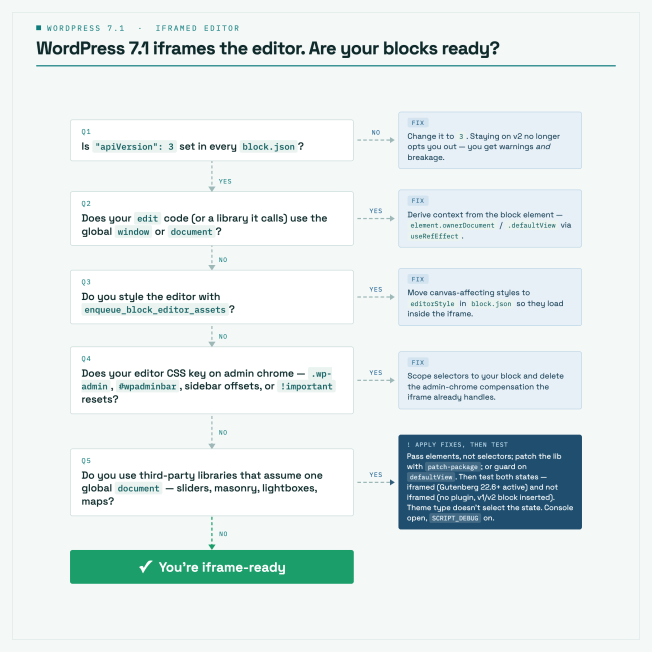
Set "apiVersion": 3 in every block.json.
Check your editor code for window. and document. — every hit is a suspect. Replace with element.ownerDocument / .defaultView via useRefEffect.
Check for enqueue_block_editor_assets — move canvas-affecting styles to editorStyle in block.json.
Check your editor CSS for .wp-admin, #wpadminbar, and .block-editor-page , admin chrome offsets and !important
Audit third-party libraries: pass elements not selectors, patch what you must.
Test both states, not both themes: iframed (Gutenberg 22.6+ active) and not iframed (no plugin, v1/v2 block inserted).
Watch the console with SCRIPT_DEBUG on — the deprecation warnings tell you which registered blocks are still on v1/v2.
A look at the impact of AI and bots on the web, emphasizing the decline of human engagement, the challenges for content creators, and the future of digital interaction.
Los campos de lavanda de Villaviciosa han sido el escenario elegido para la presentación de la novela ‘El Silencio de la Lavanda’, del escritor Tony Muñoz. Durante el acto, enmarcado en la programación cultural de la Floración de la Lavanda 2026 en la tarde de ayer, el autor anunció en exclusiva que la obra será adaptada a la gran pantalla. La producción cinematográfica estará a cargo de Telespan 2000 y Vértice Cine, bajo la dirección internacional de José Luis Povedano, mientras que el propio Muñoz se encargará de escribir el guion.
La obra, que resultó finalista del Premio Literatura Diversa el año pasado, utiliza el paisaje de Brihuega como un elemento central para narrar una historia de amor, identidad y autodescubrimiento. A través de la relación de dos adolescentes, el texto reivindica el medio rural como un espacio de crecimiento personal y diversidad. Durante la jornada se celebró un coloquio entre el autor y el periodista Daniel Valero, donde explicaron el proceso creativo y la fuerte vinculación de la historia con este municipio alcarreño.
El encuentro reunió a numerosos vecinos, visitantes y representantes institucionales, contando con la asistencia de los concejales Marcos Pacheco y Susana Rodríguez. También destacó la participación activa de la bibliotecaria Paloma Raso y los miembros del Club de Lectura de la Biblioteca Municipal Manu Leguineche. Desde el Ayuntamiento han valorado esta futura película como una oportunidad clave para proyectar los paisajes de la localidad a nuevos públicos y consolidar al municipio como un referente cultural.
De la agricultura al plató audiovisual
La evolución de la floración en Brihuega demuestra cómo el patrimonio natural de Guadalajara ha trascendido progresivamente su valor agrícola original. Al revisar el archivo histórico de Liberal de Castilla sobre el desarrollo de estas festividades, se observa que los campos morados comenzaron captando la atención mediática principalmente a través de sus conciertos de verano al aire libre. Con el paso de los años, la programación municipal ha ido diversificando su oferta para incorporar certámenes artísticos, rutas patrimoniales y encuentros literarios que aportan un mayor peso cultural a la cita estival.
La confirmación de que ‘El Silencio de la Lavanda’ se convertirá en un largometraje marca un nuevo hito en esta trayectoria de expansión. El municipio de Brihuega da un paso más allá de su condición de atractivo turístico estacional para consolidarse como un auténtico motor de creación narrativa y cinematográfica. Este salto al cine permitirá que la esencia, el paisaje y la apertura a la diversidad de la comarca trasciendan las breves semanas que dura la floración, garantizando una proyección continua de la provincia en el panorama cultural nacional.
Open Channels FM is launching a new video news show called Open Channels News, starting July 27th. It’s a quick, five to ten-minute program covering various open source topics, available live and on YouTube.
El Festival Gigante ha hecho pública la distribución por días de su duodécima edición, que se celebra los días 27, 28 y 29 de agosto en la explanada del Paseo del Ocio de Guadalajara. El anuncio permite a quienes ya tienen su abono (y a quienes aún lo están pensando) organizar su fin de semana con los horarios repartidos entre las tres jornadas.
El jueves 27 encabeza la programación La Cabra Mecánica junto a Ángel Stanich entre los nombres principales, acompañados de Calequi y las Panteras, la voz de Ángela González, el indie de Comandante Twin o el punk de Estrogenuinas. El festival abre además con una jornada de puertas abiertas: la Gigante Summer Party del jueves 27 es de entrada libre, ¡tráete tus mejores galas veraniegas!
El viernes 28 sube al escenario a La M.O.D.A. y Ultraligera al frente de una jornada que suma el rock de Repion, la fiesta de Ortiga, la actitud de Aiko el Grupo y The Molotovs, y las propuestas de Ona Mafalda, Musgö o Ruvenruven.
El sábado 29 cierra la edición con Belén Aguilera, Ginebras y la fiesta de Zahara Rave, además de Queralt Lahoz, Chimo Bayo, Kitai, Delacueva, Casino Montreal, Oslo Ovnies, Lola Vila, Late Capital y Popi&Sito.
Además, se incorporan NUEVOS NOMBRES AL CARTEL: Septeto Santiaguero, Tere!, Doplers, Los Domingos, Superframe y Miniño estarán en Festival Gigante 2026.
Las entradas de día están a la venta desde 30 euros (gastos de gestión incluidos) para el viernes y el sábado.
La programación mantiene el sello de las últimas ediciones: un cartel que mezcla generaciones y estilos, con una presencia destacada de bandas emergentes y de grupos de Guadalajara, y con un 53 % de artistas femeninas. El festival, reconocido como el más seguro de España en 2025 según los Iberian Awards, conserva su carácter familiar (los menores de 8 años acceden gratis) y su apuesta por la ciudad, con lanzaderas desde el centro y conexiones con el Corredor del Henares y Madrid.
Los abonos para los tres días están a la venta a 40 euros (gastos de gestión incluidos) en Concertados.com. Toda la información puede consultarse en la web oficial del festival.
GiveWP is the most popular fundraising and donation tool on WordPress, powering over $500 million in donations. It integrates with Akismet to ensure that spammy or potentially fraudulent submissions get filtered out. Recently, some Give users saw an unusually high level of false positives on their donation forms: legitimate donation submissions that were being marked as spam.
We investigated and found that the donation forms were being sent to Akismet for checking after each step in the donation process: once after choosing an amount, again after the user entered their name, again after they entered an optional message, etc. To Akismet, this looks like sudden repeated submissions from the same user, all with similar content (better known as spam).
Akismet supports rechecking content, but only if the integration includes the recheck_reason parameter. If that parameter is present, Akismet knows not to classify the repeated duplicate (or nearly duplicate) checks as part of a spam attack; however, if recheck_reason is omitted, this kind of consecutive similar content looks very similar to spam, and Akismet blocks it.
We reported the root issue to Liquid Web, and they quickly addressed it and released a fix in version 4.16.0. This kind of collaboration is what makes Open Source great!
We’re planning on bringing automatic integration review to more clients and platforms, so stay tuned for more tips and insights.
WordPress 7.1 Beta 1 is ready for download and testing!
This beta release is intended for testing and development only. Please do not install, run, or test this version of WordPress on production or mission-critical websites. Instead, use a test environment or local site to explore the new features.
How to Test WordPress 7.1 Beta 1
You can test WordPress 7.1 Beta 1 in any of the following ways:
WordPress Beta Tester Plugin
Install and activate the WordPress Beta Tester plugin on a WordPress install. Select the “Bleeding edge” channel and “Beta/RC Only” stream.
The scheduled final release date for WordPress 7.1 is August 19, 2026. The full release schedule can be found here. Your help testing Beta and RC versions is vital to making this release as stable and powerful as possible. Thank you to everyone who contributes by testing!
If you encounter an issue, please share it in the Alpha/Beta area of the support forums. If you are comfortable submitting a reproducible bug report, you can do so via WordPress Trac. You can also check your issue against this list of known bugs.
WordPress 7.1 will include new features that were previously only available in the Gutenberg plugin. Learn more about Gutenberg updates since WordPress 7.0 in the What’s New in Gutenberg posts for versions 22.7, 22.8, 22.9, 23.0, 23.1, 23.2, 23.3, 23.4, 23.5 and 23.6.
What’s new in WordPress 7.1?
WordPress 7.1 delivers a more complete set of styling controls, a smoother media experience, and a more personalized admin experience. Notes have evolved to add inline notes with @mentions and rich text formatting that make asynchronous feedback feel more powerful. New styling features unlock long requested features to style how blocks look across screen sizes and to style interactive states, all without writing custom CSS. Various client side media improvements means better format support, improved performance, and more resilient uploads when adding media to your site. A new inline cropping tool brings a fresh and more robust experience to editing images. Finally, the admin experience becomes easier to navigate with an ever present admin bar in the editors, improvements to the command palette, and various quality of life improvements. Underneath it all, developers get an expanding set of APIs to build on, and site owners get better support for a truly global audience.
New suite of Notes features
Notes continue to grow into a fuller collaboration experience, making asynchronous feedback between teams faster and more expressive.
Text Formatting: Notes now support inline formatting like bold, italic, code, links and adding emoji; each with a respective keyboard shortcut, so feedback reads clearly without breaking your flow.
@mentions: Type “@” in a Note to pull up a searchable list of collaborators and tag someone directly, so feedback points at the right person without leaving the sidebar.
Leave notes anywhere: Start more than one conversation on the same block instead of folding every comment into a single thread, making it easier to track distinct pieces of feedback.
Inline notes: Leave a note on a text selection instead of on an entire block.
Show more / show less: Long notes now collapse by default with a toggle to expand them, keeping the margin tidy while you write.
Style it your way, on any screen
WordPress 7.1 takes a major step toward built-in responsive design and interactive styling, letting you achieve looks that once required writing custom CSS.
Responsive styling: Define how a block looks at different screen sizes directly in the editor, for both Global Styles and individual blocks without the need of writing custom CSS.
Viewport breakpoint customization: Theme authors can now define their own responsive breakpoints in theme.json, giving more flexibility for how responsive controls behave on a given site.
Interactive state styling: Style how blocks respond to interaction, like a button changing color on hover or focus, using a standardized set of controls for both Global Styles and individual block instances.
A smoother media experience
Uploading, editing, and browsing media keeps getting more capable and more reliable.
Client-side media processing: Image and media processing moves into the browser, now with broader format support that includes HEIC (the default format for iPhone photos), UltraHDR, AVIF and WebP support built in, plus GIF-to-video conversion for lighter, more efficient files. Uploads are also more resilient, with a progress indicator and automatic retries if your data connectivity drops off.
New Media Editor Modal: A dedicated modal for editing images replaces the inline cropping tool, bringing cropping, rotation, and metadata editing together in one streamlined workflow.
Smarter galleries: Gallery blocks can automatically pull in and sort media already attached to the current post, cutting down on manual set-up.
View attached images: After you upload images to a post, the inserter will automatically surface them in a new Attached images section to make it easier to find relevant images.
Infinite scrolling by default: The Media Library grid view now loads additional items automatically as you scroll, rather than requiring a click on “Load more” especially handy for sites that handle large media libraries. This can be disabled under your user profile.
A more personal, more navigable admin
These meaningful upgrades make the WordPress admin easier to move around in and more consistent with how you like to work.
Persistent toolbar (Omnibar): The admin toolbar now travels with you into the Site Editor and Block Editor, with a series of polish improvements throughout.
Command palette improvements: Moving through the dashboard and editor with the command palette (Ctrl/Cmd+K) is more refined to make finding what you need even faster! Now results are grouped into Recent, matching and Suggestions sections instead of one flat list.
Admin color scheme in the Site Editor: The Site Editor now reflects your chosen admin color scheme instead of always using a fixed background.
DataViews and DataForms iterations: Continued refinement of the components behind managing lists of posts, pages, patterns, and templates, alongside the forms used to edit them.
Excerpts in the Posts list: The Posts list view now shows a short excerpt for each entry, making it easier to identify the post you’re looking for without opening it.
Visual revisions: This release adds a picker activity layout for browsing history in more detail, clearly labeled autosaves in the timeline, and an autosave notice that opens straight into the visual revisions view. Global Styles revisions get a small polish too, swapping the active style’s text label for a badge.
A dedicated Identity section: Site identity settings like your title, tagline, and icon are now live in their own clearly labeled section of the Site Editor, making them easier to find and update.
On This Day Widget: A new widget resurfaces what you published on this date in past years, right on your dashboard. A small nudge to look back on what you’ve written, and a reason to write something new today.
Allow Changing Comment Parent: Fixing a misthreaded comment used to mean editing the database directly. WordPress 7.1 adds an editable “In reply to” control to the Edit Comment screen, letting you pick a new parent from a dropdown of the post’s other comments. It’s scoped to the same post, so this is about untangling threads, not moving comments across posts.
New blocks and block-level enhancements
WordPress 7.1 release brings a handful of block refinements that give more control with fewer steps.
Playlist Block: A new block for adding a collection of audio files to a post or page, with an optional waveform visualization that shows the audio’s shape as it plays; a more visual way to present podcasts, music, or audio content without using any third-party plugins.
Tabs Block: A new block for organizing content into clickable tabbed panels instead of showing everything at once. It’s a cleaner way to present related content without overwhelming the page.
Background gradients: Background gradients and background images no longer conflict. The gradient used to get silently overridden by the image, but now they combine and display together. This fix extends beyond the Group block to Verse, Accordion, Pullquote, Post Content, and Quote block.
HTML block editable content: The HTML block now supports editable nested blocks. This is great to use for AI-generated content, which often arrives as raw HTML.
“Mark as decorative” for images: A new toggle on the Image block lets you hide purely decorative images from screen readers for a better accessibility experience.
Smarter shortcode handling: Pasting or converting a shortcode into the Embed block now creates a proper Embed block instead of leaving raw shortcode text behind, and the Shortcode block gains block-specific transforms of its own.
Built for a global audience
WordPress 7.1 continues work to make Core reflect the full diversity of its worldwide community, with progress toward supporting Unicode email addresses so usernames, slugs, and email addresses can better represent users everywhere.
Built for developers
WordPress 7.1 continues to expand the foundation developers build on.
Abilities API expansion: Continued refinement of the Abilities API with improved querying, filtering, and input validation, giving developers and AI tooling a more reliable foundation to build on.
Block Bindings for list items: Block Bindings now extend to List Item, making it possible to connect more block content to dynamic data sources without custom code.
Custom icon registration: New functions let plugin and theme authors register their own icons for the Icons block for use throughout the block editor.
Enforced iframed editor: The post editor now always runs inside an iframe, isolating the editing canvas from admin styles for more predictable rendering. Blocks using Block API v2 or lower should be updated to v3 for compatibility.
wordpress/theme stabilization: The package theme authors use to build block themes gets an architecture and API review, laying groundwork for a more stable, and better documented theming foundation going forward.
Connectors authentication improvements: The Connectors screen now also supports username and application-password login – a more familiar way to connect plugins and services. This release also closes a security gap where browsers could auto-suggest saved credentials into the API key field.
With so much in progress for WordPress 7.1 Beta 1, this is still only the beginning; expect continued refinement with each Beta and RC release ahead of the final release on August 19, 2026.
Just for you: a Beta 1 haiku:
Seeds of Seven-One, Notes, styles, media, and tools— Test, and watch them bloom.
¿Es el coche eléctrico aún una utopía? ¿se le puede dar al plástico una segunda vida? ¿el hidrógeno verde es tan bueno como lo pintan? ¿dónde se producen los diferentes tipos de energía que existen? Son algunas de las preguntas a las que ha dado respuesta el quinto y último curso de verano de UNED Guadalajara, celebrado en el Centro San José entre el 13 y el 15 de julio.
Bajo el título ‘Energía hoy: reto, crisis y futuro’, una decena de expertos, la mayoría del ámbito de la ingeniería industrial, han reflexionado desde una perspectiva global, actualizada y critica, el presente y los retos del sistema energético mundial, con especial atención al caso de España, analizando las principales tecnologías, infraestructuras y transformaciones que marcarán los próximos años, en un contexto sostenible.
“Hemos querido combinar análisis técnico, económico y regulatorio, ofreciendo además claves para interpretar los desafíos de la transición energética hacia un modelo más eficiente”, afirma la directora del curso, Mercedes Ibarra, Doctora con más de 10 años de experiencia en investigación e innovación en ingeniería energética y ambiental y Profesora Permanente Laboral en el Departamento de Ingeniería Energética. ETSII UNED.
Más energía pero más sostenible
La energía eléctrica no existe y hay que generarla a partir de las fuentes de energía naturales. El sol, el agua, el viento… conforman una valiosa materia prima que, transformada, permite que hoy se pueda encender una luz o que se desarrolle la industria.
Bajo esa premisa, el mix energético que vive España, donde en diferentes porcentajes se genera energía solar pero también hidroeléctrica, eólica y nuclear, se percibe como una buena situación que indica que se camina por la senda correcta hacia el objetivo principal: la descarbonización y la reducción de la huella de CO2. Este curso ha permitido entender que en todo este proceso, existen alternativas energéticas, diferentes combustibles y diversos centros de producción, pero también que el mercado, la competencia, el marco regulatorio, la seguridad o el almacenamiento energético son agentes que intervienen y definen un sector que se mueve entre energías renovables y no renovables, ‘fabricadas’ en diferentes centros de producción.
Además de conocer cómo funciona la red de distribución eléctrica -desde los grandes sistemas a las redes activas y las microrredes- este ciclo sobre energía ha ayudado a comprender también los desafíos actuales a los que se enfrenta el sector para garantizar el desarrollo del sistema: la saturación de la red, la vida útil de las baterías y el reciclaje.
Biocombustibles y renovables
Asimismo, se ha profundizado en las diferentes formas de energía renovable que existen -desde los parques eólicos hasta las plantas de biomasa- y nuevas alternativas energéticas como el hidrógeno verde, analizando sus diferentes colores, sus aplicaciones en el transporte y la industria y las luces y sombras que se derivan de su coste elevado.
En paralelo, se ha examinado el papel de los biocombustibles avanzados, desde sus primeras generaciones hasta los desarrollos más recientes, en el contexto de las políticas de descarbonización impulsadas por la Unión Europea. También se ha reflexionado sobre el desarrollo del vehículo eléctrico, con especial atención a sus retos actuales, que pasan por la recarga, los aspectos regulatorios y las limitaciones actuales del sistema.
Finalmente, se ha analizado la relación entre industria y energía, poniendo de relieve la eficiencia energética y la electrificación y cómo las limitaciones en el suministro energético están condicionando inversiones estratégicas y obligando a replantear el posicionamiento industrial.
Con este curso de verano sobre energía finaliza la 20ª edición de los Cursos de Verano de UNED Guadalajara. La directora del Centro Asociado, Lorena Jiménez Nuño, subraya la «oferta variada, de calidad y rigor académico» de este año, que pone de manifiesto que «nuestros cursos de verano son espacios para el aprendizaje y para compartir conocimiento con magníficos ponentes».