Messaging is emerging as the universal interface for interacting with technology, simplifying complex tasks into straightforward communications akin to texting, thereby enhancing productivity and reducing technical barriers in digital engagement.
Blog
-
Open Channels FM: Aligning WooCommerce Marketing Strategies for Community Success
In this episode we’re chatting about a topic that matters to everyone in the WooCommerce world and beyond: how OSS communities can come together to market themselves more effectively.
-

How to See WPBeginner Articles First in Google (In 2 Clicks)
If you love WordPress and rely on WPBeginner for tutorials, tips, and guides, then we want to show you an easy way to make sure you can easily find WPBeginner tutorials when you search on Google.
Google search offers a feature called ‘Preferred Sources.’ This lets you choose websites with the content you want to see more of in search results.
Instead of scrolling through multiple pages of search results, you can make it easy for Google to show the most relevant WPBeginner articles, so you get the WordPress guidance you need, fast. 🎯
In this short guide, we’ll walk you through exactly how to set up WPBeginner as a Preferred Source in Google search (it only takes two clicks).

💡 Why Set WPBeginner as a Preferred Source in Google?
Setting WPBeginner as a preferred source ensures that our WordPress tutorials and guides appear in the ‘Top Stories’ section and the special ‘From Your Sources’ section in the search results.
This way, whether you’re troubleshooting a plugin, customizing a theme, or fixing an issue on your WordPress website, you’ll see WPBeginner content first. It will save you time and help you get the answers you need faster.
This is especially important when you consider that AI (artificial intelligence) is playing an increasingly bigger role in deciding what appears in your Google search results. Setting up your preferred sources means you can get the content from trusted websites.
Here’s how to set up WPBeginner as a preferred source in Google:
1️⃣ Step 1: Go to Google Source Preferences for WPBeginner
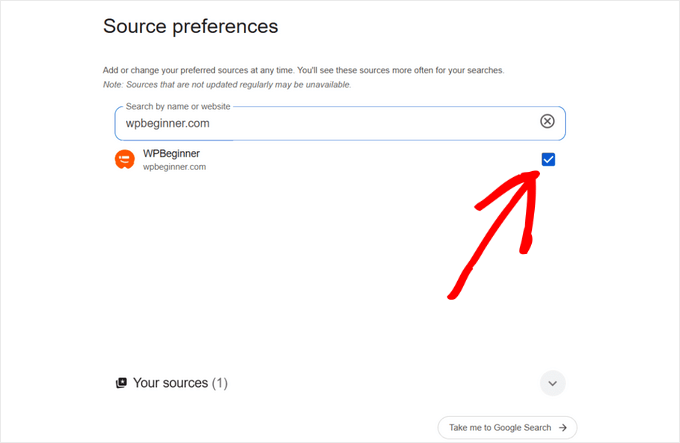
First, simply click this link. You’ll be taken directly to WPBeginner in the Source Preferences list.
2️⃣ Step 2: Select WPBeginner
Next, click the checkbox next to WPBeginner to add it as a preferred source. ✅
3️⃣ Step 3: Refresh Your Results
Once you’ve selected WPBeginner, simply refresh your Google search results.
That’s it! You’ll now see WPBeginner content more frequently in the ‘Top Stories’ and ‘From Your Sources’ sections, making it easier to find our new tutorials and guides.
Keep Up to Date with WPBeginner
Adding WPBeginner as a preferred source is just one way to keep up to date with our latest articles.
You may also wish to:
- Subscribe to our email newsletter to receive our latest news, tips, and offers.
- Join our WPBeginner Engage Facebook group and get help from real WordPress users.
- Subscribe to our YouTube channel for our latest video tutorials.
We hope this article helped you learn how to see WPBeginner articles first on Google. You may also want to check out our ultimate WordPress SEO guide for beginners, or take a look at the best WordPress plugins we use daily to run our sites.
If you liked this article, then please subscribe to our YouTube Channel for WordPress video tutorials. You can also find us on Twitter and Facebook.
The post How to See WPBeginner Articles First in Google (In 2 Clicks) first appeared on WPBeginner.
-
#222 – Destiny Kanno, Anand Upadhyay, Maciej Pilarski on How WordPress Education Programs Are Growing
Transcript
[00:00:19] Nathan Wrigley: Welcome to the Jukebox Podcast from WP Tavern. My name is Nathan Wrigley.
Jukebox is a podcast which is dedicated to all things WordPress. The people, the events, the plugins, the blocks, the themes, and in this case, how WordPress education programs are growing.
If you’d like to subscribe to the podcast, you can do that by searching for WP Tavern in your podcast player of choice, or by going to wptavern.com/feed/podcast, and you can copy that URL into most podcast players.
If you have a topic that you’d like us to feature on the podcast, I’m keen to hear from you and hopefully get you, or your idea, featured on the show. Head to wptavern.com/contact/jukebox, and use the form there.
So on the podcast today, we are joined by three WordPress Education Initiative leaders, Destiny Kanno, Anand Upadhyay and Maciej Pilarski.
Together, they have spent years at the heart of WordPress training and outreach, working in roles spanning community education management, plugin development, and credit program administration. Their efforts have helped shape student engagement and university partnerships across the globe, introducing thousands of learners to WordPress.
The conversation focused on the current landscape of WordPress education with particular attention to three key initiatives, the WordPress Credits Program, Campus Connect, and Student Clubs.
Each initiative is designed to provide unique entry points for students of all ages and education levels. From high schoolers building their first site in a library to university students earning official credits for open source contributions.
We discussed the different approaches these programmes take. WP Credits ties student work directly to academic credit and mentorship. Campus Connect provides flexible, community driven, events in diverse locations and Student Clubs foster sustainable, peer led, learning within schools and other institutions. We explore how these models feed into each other, building a sustainable ecosystem for ongoing growth in the WordPress community.
We also get into the importance of repeat campus partnerships, the need for scalable facilitator training, and the role of recognition, certificates, badges, and public showcases in keeping students motivated and validated in their journey.
If you’re curious about the growing movement to bring WordPress knowledge to the next generation, or are looking to get involved with education in your local community, this episode is for you.
If you’re interested in finding out more, you can find all of the links in the show notes by heading to wptavern.com/podcast, where you’ll find all the other episodes as well.
And so without further delay, I bring you Destiny Kanno, Anand Upadhyay and Maciej Pilarski.
I am joined on the podcast by Destiny Kanno, by Anand Upadhyay and Maciej Pilarski. Hello, one and all. Nice to have you with us.
[00:03:29] Destiny Kanno: Hello. Thank you.
[00:03:30] Anand Upadhyay: Hello.
[00:03:31] Maciej Pilarski: Hello.
[00:03:32] Nathan Wrigley: So a few months ago, back in, I think it was September 2025, I was joined by two of the three participants on the call today. I was joined by Destiny and I was joined by Anand. We were also joined at that point by Isotta, but she’s not on the call today. We’ve obviously got a wonderful replacement, Maciej who’s going to do a fabulous job explaining the bits and pieces here.
But the intention of that episode, which you can find on the WP Tavern website, it’s episode number 183, was to find out about all of the overlapping education initiatives in the WordPress space. And it was born, I think, largely out of a sense of curiosity on my part, but also a somewhat sense of confusion, because there were lots of things which were going on. Some of them seemed to be slightly overlapping. There was a conflict of names in some cases. So that episode was laying out the groundworks of what has been happening in the WordPress space.
When that conversation finished and we’d click the stop record button, I said, that was absolutely fascinating. This seems to be moving at such a rate, wouldn’t it be good to revisit this whole subject in about six months time?
Well, we missed that target, but here we are, maybe eight months later. I think my intuition at that point was correct, because being a close observer of what’s going on in the WordPress community, I think it’s fair to say that the educational space has been somewhat turbocharged during the last eight months.
And so today’s episode, with the help of the three people I’ve just mentioned, is to describe what’s going on, what’s changed, maybe some things that have been mothballed, but certainly a lot of things that are new and interesting and have gained a lot of momentum.
But I think, dear listener, the intention of this episode is to get you involved. Is to get to the end of this episode and for your curiosity to have been turned into action. To have gotten you out of your chair, written an email, turned up to an event, helped organise a thing.
So please have that in the back of your mind. If you’re sitting listening to this in a car, at your desktop, there is actual action that could be taken at the end of this. I think the intention of all four of us on this panel would be dearly for that to happen.
Okay, let’s establish the credentials of the people that we’re going to be talking to today. So we’ll just do a little potted bio of you one at a time. So we’ll begin with Destiny, if you could just tell us a little bit about you, your relationship with education in the WordPress space, I suppose would be apropos.
[00:06:01] Destiny Kanno: Yeah, absolutely. So again, Destiny Kanno. I’m currently working as an education program manager sponsored by Automattic. And I work directly with the Make WordPress Community Team. And I also work adjacently with the training team as well, because education training materials, they go pretty hand in hand. And I’ve been doing this now for about four years and, yeah, it’s just evolved since my original time working on Learn WordPress, and that relaunch that happened, to now, yeah, these wonderful programs that are spreading like wildfire as you said.
[00:06:37] Nathan Wrigley: Fantastic. Thank you so much. Okay, we’ll move over to Anand for the same sort of introductory moment.
[00:06:43] Anand Upadhyay: Yes. So my name is Anand Upadhyay, and I run the WordPress plugin development company, WPVibes. Apart from that, I’m very much involved in the WordPress community and I contribute in multiple ways. It can be documentation, it can be Core, Polyglots. But I’m also keenly involved in the community part, and specifically I can say with the education initiatives, I started with WP Campus Connect in WordPress Campus Connect in 2024. And since then, after that we started joining hands with Destiny and we started evolving this program in a much bigger shape. So that’s it.
[00:07:16] Nathan Wrigley: Okay. Thank you so much. And last, but by no means least, Maciej.
[00:07:20] Maciej Pilarski: Yeah. Thanks for having me. My name is Maciej Pilarski. So I’ve been doing anything related to WordPress pretty much since 2007, so that’s been a while. But the biggest breakthrough for me was 2014 when I actually volunteered to WordCamp Europe in Sovia, Bulgaria. That opened my eyes to the whole community, everything that is happening around WordPress.
And since then, pretty much I’ve been working for multiple companies from the WordPress ecosystem. I joined Automattic in 2016. For many years I’ve been a Happiness Engineer, and since October last year, I’ve joined Isotta as one of the admins of the WordPress Credit program. And since that time, I will have been helping her out to grow that initiative.
And Destiny mentioned, it spreads like fire because at that time we had six universities onboarded, now we are at 21. The 21st, we got it after WordCamp Asia actually through a connection made there. And it’s our first institution from Africa, from Uganda. A huge shout out to Stephen Dumba, who I connected with during the event. And after that, pretty much a week after we signed our first partnership from Africa. So we’re actively growing and getting new institutions on board.
[00:08:42] Nathan Wrigley: Thank you so much. Gosh, there was an awful lot in there, wasn’t there? That was really interesting. We’ll try and unpack quite a lot of that.
Firstly, a sort of slightly personal message from me. I don’t usually reveal much about myself on this podcast. I take the position that I’m a, kind of like an interested party, but don’t really give much of my own thoughts. However, this is different because I cannot think of a more interesting, meaningful, moral, let’s go with that word as well, use of time than educating people. It simply is the most profoundly useful thing to do with your life.
Now, obviously people will have different opinions about that, but the juxtaposition of free open source software, in this case WordPress, and education is a real sweet spot for me. I just think that is such an amazing thing to be involved in, to have going on in the background.
If you think about it, an open source project, like how many open source projects have this level of stuff going on in the education space, this real international footprint. Things going on which we’ll find out about in a minute. It’s really fascinating.
And I am sure that the listenership to this podcast, the vast majority of people listening will never have encountered much of this before. Maybe they’ve seen stuff on Learn because they want to technically learn about WordPress in an online capacity, but we’re going to be delving into real world events affecting real adults, real youngsters.
And so anyway, that’s my little bit at the beginning, just how curious it is that the project is so big that we’ve got this international footprint of education. And so I suppose what we should do right at the beginning is lay out the different initiatives and just name them, and try to figure out how they differ from each other. Just so that we’ve got some kind of awareness.
So I don’t know which one of you wants to take that, but if maybe you take one each or something, I don’t know. If we just want to lay out the, just erect that tent basically so that we know what the initiatives are called, and how they differ from one another. So I’ll open that up. Whoever wants to step in.
[00:10:48] Maciej Pilarski: I can start with the Credits Program. So the Credits Program is based, it’s a contribution based program, internship, initiative by the WordPress Foundation that connects higher education students with the global open source community. So basically it’s an opportunity for the students as part of the educational curriculum to contribute to the WordPress community.
There are two types of courses that the students can do. One of them is 50 hours, the second one is 150 hours. Usually the students do that during a full academic semester. And as part of that, students are first onboarded into the WordPress ecosystem and the wider open source ecosystem where they learn not only about WordPress, but open source as a whole, and how crucial it is for the internet.
Then the second phase is picking the contribution area to which they would like to contribute. All the contributions areas basically are the ones that are listed at make.wordpress.org. So any team that is listed there, students can pick from that area. During that phase, they work on a particular area that they have selected.
And finally, during phase three, they wrap up the whole achievements, the contribution, what they did, they publish a final post. And what is also very important as part of the credit scores, students have also assigned a mentor from the WordPress community that guides them through the whole process. We don’t leave them alone. We connect them with actual mentors from the WordPress community that are vetted by us, that guide them through the whole journey into the contribution and the whole WordPress ecosystem.
So it works on multiple levels. For me, this connection is also special because it builds this bridge between the previous generation of WordPress contributors to the new one where they are introduced and can start working on any fields of contribution.
What is also important is that this is not limited to technical universities. Pretty much any type of university can participate in the program. The first university that we started with was University of Pisa, and it was the humanity studies. So the students from humanity field were the first group who started the Credits Program. There’s room for pretty much anyone from any field.
[00:13:18] Nathan Wrigley: Okay. There’s a lot there. Wow. I’ve just been taking notes and I’ve almost filled an entire A4 page. So WP Credits, the WordPress Credits Program, I guess the name sort of gives it away. The idea here is that you trade time for university or higher education credit. So credit being, I suppose if you were to atomise your three year degree, you might do, I don’t know, 12 modules or something like that. The idea is that one of those modules, perhaps it’s more, becomes something in the WordPress, but also curiously the free open source software space as well. I didn’t actually know that.
The idea is that you link up with real world institutions. So the first one was Pisa, and maybe we can get into which other ones have come along. And in exchange for 50 hours or 150 hours, you will be given that credit, which can then go to the overall awarding of a degree or whatever it is that you are hoping to get.
You’re then linked up with team members, WordPress community team members who will mentor you and shepherd you through this process. And the idea is that it culminates, I think you said in a final post, which I suppose in a sense is a bit like a dissertation or something like that, you sum up all the different bits and pieces. Yeah.
[00:14:29] Maciej Pilarski: Once that happens, the students also receives an official certificate from the WordPress Foundation, signed by Matt himself, that certifies that they completed the course. And what is also important to know, the whole progress through the course and what they did during the course, it’s also stored on the wordpress.org profile. So any contributions that they did, for example, photos that they’ve uploaded, this all will be visible on the wordpress.org profile. And they also receive a special badge dedicated to students who graduated from that program.
So it really gets them started into the WordPress ecosystem, and at the same time creates something like a small portfolio for any future company that would like to, for example, hire them. Because they have a proven history of contributing to the ecosystem.
[00:15:20] Nathan Wrigley: Okay, so that’s an interesting quid pro quo, isn’t it? So the idea is you do all this work, which on the face of it, I suppose looks very philanthropic, you know, you’re giving up your time, but you get a real thing at the back end of it. You get a certificate. You can then presumably apply for jobs and indicate, okay, I’ve done this, I’ve contributed in this meaningful way.
What I think is really interesting there, and it kind of gets lost, I’ve worked in education in the past and I know the red tape that’s involved in doing anything in the education space. There is so much red tape. And I can only imagine what’s happened in the background to enable these kind of things. You know, the back and forth, the tennis of emails that go on and on and the proof that’s required to categorically show that this thing that we are doing is worth something. You know, it’s not just this Mickey Mouse. We use that expression, Mickey Mouse kind of qualification that really, it doesn’t actually require any hard work. It’s just there, nothing really in it, but you get an accreditation anyway.
I can only imagine the hard work that has gone in every single time you touch a new institution, trying to convince them that this is legitimate, that this is real. You’ve just kind of glossed over all of that by just describing what is in existence, not necessarily what has gone on to make it happen. I know that there’s probably more than the three of you involved in this, but my profound thanks for all of that hard work, which presumably is utterly and completely invisible. And I can only imagine what’s going on there. So yeah, thank you for all of that.
[00:16:54] Maciej Pilarski: Thank you for that.
[00:16:54] Nathan Wrigley: So that was WP Credits. So that was one wing of the things that we’re going to discuss today. Should we move on to another one and maybe somebody else wants to take the helm?
[00:17:03] Anand Upadhyay: I think Destiny can take Campus Connect and then I will take Student Clubs.
[00:17:06] Nathan Wrigley: Okay. Destiny, let’s move over to you and see what you can tell us about something different.
[00:17:11] Destiny Kanno: Yeah, so I’d love to tell you more about WordPress Campus Connect. And the way we ended with WordPress Credits, I think is also very critical to the story of Campus Connect because, you know, it started with Campus Connect first, and that’s how organisers such as Anand and Pooja like were able to get those connections with the universities through being boots on the ground, you know, having those relationships. Proving through action that these activities that we’re doing with the students are having real impact and are showing real results.
Slowly building up these kind of case studies in a way has helped open a lot of doors, especially with Campus Connect now, we’ve done a lot of events, especially since we last talked. Like I think this year alone, we’ve already had 22 Campus Connect events. So, like it’s not even half the year and it’s quickly becoming one of the biggest run events, WordPress official series.
But these events are like a way of opening the door, right? Hey, here’s a free learning opportunity for your students. And as you said, like the red tape is there. A lot of institutions are like, wait, so what’s in it for you? Why is, there’s a little bit of dubiousness sometimes in the reaction, right? You’re going to give your time to educate our students, why? But once they see, it’s like, no, we really are just passionate about spreading WordPress, showing students what’s capable with their website, how it applies to different skillsets as well. Like it’s not just for coders, it is for marketers, it is for designers.
You know, there’s so many career opportunities that once we just get the foot in the door and we’re able to showcase that, a lot of institutions are like, okay, now I get it. I do want to highlight in Anand’s case, like they’re going to have their third WordPress Campus Connect in Ajmer this year. You’ve got repeat institutions. I’ve heard you also have institutions that are like, when are you going to come to our place and teach WordPress? You know, once the fire is lit and people see how bright and shiny it is, like people want to get involved.
But as you said, like getting it to click for people, that is like the most difficult part. And I’ll give an example of, right now in Japan, we had our first WordPress Campus Connect event on the 9th of May. So I’m like, woo hoo. Like it finally happened. But we have this community in Japan that is like very passionate, very active. So when I first was like introducing the concept of Campus Connect, people were like, okay, but like how do we do this? What’s it about? It takes like a lot of presentations, a lot of going to people in person and talking. Helping them even shape the conversation that they’re going to have with the institution to sell this amazing gift of WordPress on their campus.
And after this one on the ninth, like now we have a case study in Japan that others can now use to be a starting point for those conversations going forward. So I think, once you have that one step, the gate just slowly opens until it’s just, the doors bang open in each way. But yeah, we’ve seen really great success with Campus Connect and it’s just like honestly, it just keeps growing.
[00:20:30] Nathan Wrigley: Can I just ask a quick question? So I just want to draw a very clear line for everybody that’s listening to this, what the difference may be between Campus Connect and WP Credits. Because from the description that we’ve had so far, it may be that you’ve fallen into the trap of thinking, well, they sound like they might be the same thing. So could you just, Destiny, just tease out where Campus Connect differs? Maybe in the nature of the event, the timing of the event, the availability, the age group, those kind of things that separate WP Credits from the Campus Connect initiative.
[00:21:02] Destiny Kanno: Yeah. Thank you, that’s like a really great distinction to make. So whereas WordPress Credits is geared toward higher education, Campus Connect is geared toward, honestly any level of students as long as they’re able to browse the web safely, and enjoy and participate.
So that means, Elementary school students now are pretty good at devices. High school students, college students, vocational students. We honestly kept the door pretty open in terms of what a campus means. We’ve even had a Campus Connect event in Uganda in a library, the Lira Public Library because students were able to go there right?
We were trying to make it as barrier free for students wherever their campus is. And so that’s, I think, the main difference. It’s more wide ranging in terms of who can participate as a student. And then also the fact that it could be a one-off event, so a one day event. A lot nowadays are multiple day events, they’ll maybe go two times out of a month, or a couple days consecutively. And then after that it’s up to really the organisers in the institution whether or not we have another addition on their campus the same year, or the next year.
[00:22:15] Nathan Wrigley: I’m going to tease out a few things. I just want to point out to, me as an English person, that is to say, not an English speaker, but somebody from England, campus has a really defined definition, and it’s usually bound to a university. Whereas it sounds like the description here, campus literally means the place where education happens, not it’s 18 years old and older, you know, people doing degrees, bachelors and PhDs and that kind of thing. Basically, if there’s an institution somewhere, that’s what the campus is in this case. Okay.
So the WP Credits program sounds like you forge your relationship with the university, and correct me if I’m wrong, it sounds like it takes place inside that institution, and it’s part of that program and what have you.
The Campus Connect initiative is much more ad hoc. It could be a one-off, it could be monthly, it could be inside a library, it could be inside the school, it could be an inside an institution. It feels a bit more like, I don’t know, a WordPress Meetup, but geared towards a younger audience or something like that.
And the minimum age requirement is really driven by your capacity to type on a keyboard and hold a mouse and those kind of things. And that’s kind of curious to me because I think my educational experience was always younger children. It’s really interesting how patterns are laid down at a very, very early age. Patterns that go on into much later life get laid down, typically at incredibly young ages. So this is fascinating for digging into that.
And it’s not just about, say, the code, it sounds like code is on the menu, but it could be about marketing, it could be about design. Basically the gamut of anything online, CMSy, those kind of things. Okay, is there anything you want to add? Did I misunderstand anything there, or misstate anything there?
[00:24:02] Destiny Kanno: No, I think you’re completely right. We’re trying to convey that WordPress isn’t just a blogging software that I think is still a lot of people have a mentality of. Like there are many ways to utilise it that goes beyond that.
And one thing I did want to add are a couple numbers. So since WordPress Campus Connect became official in May of 2025, an official WordPress event series, I should say, we’ve had 42 completed events, with 71 participating institutions, and over 5,500 students have been reached.
[00:24:37] Nathan Wrigley: That’s something else. 42 events, 71 institutions, and I think you said five and a half thousand individuals. Good grief. I don’t know what the measure of success is for this, but that feels like success to me.
I mean, imagine turning up to a WordCamp, like a flagship WordCamp and five and a half thousand people descending on you. You’d feel slightly overwhelmed. That’s a lot, isn’t it? Gosh, that’s pretty remarkable. Wow. Congratulations.
[00:25:05] Destiny Kanno: And the majority, the outcome, the students make a website. So we could almost count those students as also new WordPress websites that are live now on the web. So within a year, organisers around the world have been able to make that happen.
[00:25:19] Nathan Wrigley: Could I just perhaps draw another distinction as well, just very quickly, because it sounds like the WordPress Credit system, because it’s binding itself to institutions, it sounds like there might be more paperwork going on there, and maybe more high level meetings that need to take place. Whereas Campus Connect feels much more community driven. It’s the kind of thing that, quite literally, anybody listening to this podcast with a fair wind could have one of those going in a handful of months. If they’ve got the right initiative and they can find the audience for that.
Again, is that about right? There’s sort of more opportunity to become involved with the Campus Connect initiatives. You don’t need to have that academic background or have a point of contact at a university. You basically just need a building, some interest and a bunch of students.
[00:26:02] Destiny Kanno: Yeah, the key thing is, you know, having a real connection to the campus that you’re going to present at. But you’re exactly right. We tried really hard to lower the barrier to organise these events. Because I don’t know if you’ve organised a WordPress event before, there’s kind of a lot of hoops you have to jump through. And we’re like, okay, how can we think about this in a different way?
And I think that also has positive repercussions for how we organise other events too, that are, changes are being thought about too so that we can enable people and empower them to put these events, instead of bogging them down and process and a little bit of bureaucracy to say.
[00:26:38] Nathan Wrigley: So what’s really curious about that as well is we’re all in different parts of the world, aren’t we? People on the call today are in Japan and I’m in Europe and, Anand, are you in India? I think.
[00:26:47] Anand Upadhyay: Yeah.
[00:26:47] Nathan Wrigley: Yeah. Each of those events, I guess would look quite different. The kind of nature of the attendees, the nature of the kind of building it might be in, the institution. And it really is, you just grab what’s around you I suppose, and work with that. If you’ve got a connection to an institution, you can go for it. Maciej, I feel like I crosstalked you. I think you wanted to say quite a few times and I’ve just interrupted. I’m very sorry.
[00:27:08] Maciej Pilarski: No worries about that. So I wanted to add that those initiatives set backgrounds for each other. Because in some uni institutions, the interest sparks with a Campus Connect event, and that gets the institution interested in those initiatives, which sets background for WordCamp Credit.
And it happens also the other way around, where we start with an institution that starts credits and then we get the students interested in WordPress in general, the community, which leads to a Campus Connect event during the Credits Program. What is important is that those initiatives don’t compete with each other. They support each other.
[00:27:51] Nathan Wrigley: Right, so there’s a lovely virtuous cycle there, isn’t there? Where the two things can be going on in harmony, one promoting the other and they’re definitely not in competition. Okay. That’s really interesting.
One final question on Campus Connect, and I’ll direct this at Destiny, just because she’s been handling that. With the WP Credits thing, there is this moment where you hold the certificate in your hand and you go, yay, did it.
Is the same thing true of Campus Connect or is it more of a show up to the one event, you know that you did that, that was great, you can file that away in your own head as a thing? Or is there some sort of accreditation, or certificate giving, or badge giving, or profile updating that might go on on wordpress.org? Is there any sort of thing that the attendees receive, and I suppose that the people that are organising might receive as well?
[00:28:37] Destiny Kanno: Yes. So we do have a certificate of participation that students can receive signed by WordPress Foundation Executive Director, Mary Hubbard. And that just needs to be requested by the organisers ahead of time, because we need to get the signature and all that. So yes, they can come away with that. And we’ve heard really positive things about that, like it motivates them. They’re like, yeah, I did something, which they did.
[00:29:01] Nathan Wrigley: There we go. That was WP Credits and WP Campus Connect.
Can I just say at this point, dear listener, if at this point you’re thinking hang on a minute, there’s a lot going on here, don’t worry, there’ll be show notes. If you go to the WP Tavern website, there’ll be show notes. I’ll try to list out as many sensible links to get you to the root of each one of these initiatives, so that you can begin your journey and fan out from there.
I’m not sure what episode number this will be, but if you just go and search for, oh, I don’t know, Destiny or Anand or Maciej, you could probably find the episode that way. And all the show notes will contain all of the links.
Right, in which case, I think it might be Anand’s turn. What have you decided to take on Anand?
[00:29:39] Anand Upadhyay: So I will be sharing my thoughts on the third part of this whole education initiative ecosystem. So that is a Student Club. Just a few minutes before you were giving the analogue of meetup with this Campus Connect. So I would like to share the same analogue with us because we are more accustomed with like other terms of WordCamps and Meetups and contributer days.
WordPress Campus Connect is kind of like a WordCamp happening in the campus, because it’s like a big day event that holds everything happening, different kind of sessions, maybe workshops happening. So I would compare it with that thing.
And same way, credits thing, Credit Program is kind of like ongoing contribution series because more focused on the contribution part because the student devote 150 hours of their program. A lot of period goes to the contribution.
And now the same way we, if we talk about the Student club, it’s similar to like the Meetups that we have. But these are the in campus meetups for the students and by the students. How do things get started? Like the Campus Connect introduce the WordPress to those campuses and to those students, but since most of the campus, it’s a once in a year event. So once this event has sparked something about the WordPress in the students. So keeping that momentum going on, that’s where the Student Clubs come in.
So with the Student Club, it’s kind of like, as I mentioned, it’s like an in campus meet program. So a student can gather themselves, they can form a club and a couple of students can be nominated as club organisers, student club organiser from their campus. And then they organise the in-campus events, maybe like once in a month or twice a month, depending on academic calendar. There are a lot of hurdles in doing those things continuously.
But they usually do once or twice a month. They do a kind of a meetup in their campus. The students gathered together. They learn from variable resources available from WordPress. And from those resources, they share with the other students. It’s kind of a group learning, group study, that we use. Education live, we always do that. It’s kind of a group study. They’re learning from themselves. If someone has learned something, they are helping others to learn those things.
So I would just like to give some of the examples from my city. There are multiple Student Clubs are going on. When we went to the campus, we just taught like a small group of students about the WordPress, because we’d have some limitations of the resources, of the setting arrangement. We cannot call all the students of the campus and, okay, come together and I have a amazing workshop. So we have given the WordPress walk through to the limited number of students.
After that, they form a Student Club in their campus because they got very much interested. Then the first session they did was like, they started teaching to their juniors, like the students who have just entered the campus. They took a session for them. So they told, whatever we have told them, they have taught the same thing to the juniors.
After that, in the next few session, they experimented different things. Like in some session they’re just doing a fun quiz around WordPress. And in some sessions they are doing a kind of like a, I would say like a hackathon kind of thing. So they are just picking up a website. Or you can, just similar to the speed build challenge that Jamie do. So they have just one website open on the screen and everybody’s like cloning that website.
So there are different ways students are engaging through those student clubs. So it is helping to keep the momentum going on so that the student keep learning about WordPress and they are also connecting with the community members for the guidance about how they can learn more. What should they learn next if they are sharing their experience. Like we have covered these things and, what should we go next?
And in the recent WordCamp Asia, they’re also one of the Student Club lead from my city. She joined the event and there are conversation with the, like other community members who has offered them like, okay, we can come to your campus, or we can do, have a webinar for your campus where we can teach you particular subjects, particular topics. Maybe they can talk about SEO, maybe they can talk about plugin development.
So this is also opening the horizon for them, to learn from people across the world. So that is how the Student Clubs are happening. The examples I’ve gave, again, from my own city because I’m closely mentoring them, but there’s similar things are happening across the world.
So it is helping to create a kind of sustainable environment for the long-term sustainable environment in the campus. So the next time when we go to that campus, we are not going to teach like the basics of WordPress, because we want like, the ecosystem should be built within the campus, so every student know about the WordPress. Because last time when we went to the campus, we have to tell everything about WordPress because why you should learn WordPress.
So the Student Clubs, my ambition is that, wherever the Student Club is from, next time a Campus Connect event is happening, next time we should not tell them about what is WordPress and why they should learn this thing. There should be already a sustainable ecosystem.
And I feel that all these three programs are like very much interconnected. And the real impact of these programs, we will be able to see in the next two or three years. And there will be a regular ongoing activities around WordPress in the campus.
And these are also kind of a balance program as well. Like the Campus Connect is introducing WordPress to the students, Credits Program is motivating them more towards like the contribution part. And I would say that Student Clubs is more inclined towards getting new users to the WordPress. Because if we keep on focusing on the contribution, contribution, but if we discard the like increasing the number of new users, so we are not going to win. We need a balanced state.
The Student Club is trying to, learning how to build website, how to mastering the skills of the WordPress. And later on, many of them are going to join the contribution part as well.
So this whole ecosystem is built around bringing more people to the contribution, bringing more people to use WordPress, build websites, as in, for the individuals as a business as well. So that’s how all these three programrs are very much interconnected, and growing together fast.
[00:35:16] Nathan Wrigley: It feels like, of the three things that we’ve talked about, so WP Credits, Campus Connect, the Student Club, this final one that you’ve just covered, it feels like that’s got a very flat hierarchy to it. In other words, there’s like this peer learning. So it feels like more or less anybody can show up and demonstrate anything, which might then lead to somebody else thinking, okay, that was interesting, I’ll take on next month’s one because I’ve now seen that’s doable. Less hierarchy, if you know what I mean? So a much more flat structure.
[00:35:45] Anand Upadhyay: Because when we started Campus Connect, we also get a lot of attraction in the local community as well. And people join our Meetup groups. But then it becomes difficult for us, how to plan about the topics for our meetup. We have some experienced professionals coming in. We have some students coming in, and we plan the topics that suits the professionals. The student will feel like, okay, what’s they’re talking, we are not getting anything in our mind. If we bring the topics, very basic topics and the professionals who are joining the community meetups, they’ll feel like, okay, these are very basic stuff, why am I coming here?
Student Clubs giving them their own platform, giving them a own opportunity. Okay, these are all the familiar faces. It is also giving the opportunity to come on the stage, come onto the stage and get out of your fear as well. It is also generating leadership qualities in them. Okay, we have to keep this momentum going on and we have to keep the activities going on. So there are a lot of ways, apart from learning WordPress, there are a lot of other ways it is helping the students as well.
[00:36:40] Nathan Wrigley: When you have to stand up in front of a bunch of people and deliver something, obviously there’s a whole bunch of us that are just really confident at doing that, quite happy to stand up and do that kind of thing off the bat. But equally, there’s people for whom that is just the most terrifying experience possible. You know, standing up in front of two or three people, oh boy, you know, anything above that is just off the books.
And I was just wondering about that, whether or not there’s, in this particular style of event, the Student Club, whether there is a growing corpus of, I don’t know, previously done topics or topic suggestions or slide decks or anything like that, which might enable people to feel that level of confidence? I don’t know if that’s something which is being put together. Just resources which enable somebody who doesn’t have the confidence, let’s go with that word, who then may gain that confidence. And I’m going to pass this to Destiny because she’s waving her hand.
[00:37:30] Destiny Kanno: I was really hoping I could shamelessly plug this project. This is like, you’ve said the most opportune thing. So I’m actually developing right now what I’m like tentatively calling the Meetup Activity Library. It comes with like kits on certain topics. So for example, WordPress Playground was the first one I built. But it comes with the facilitation guide, which is a doc. So the facilitator can read through, understand the steps they’re going to go through in the activity, how to pace it. And then a presentation deck which they would display, if that’s available to them, to the folks that they’re presenting to. And it’s a hands-on activity only. So it’s not only presentation. The facilitator of course guides and talks them through things, but then people are getting hands-on experience with that topic along the way.
[00:38:16] Nathan Wrigley: That is a beautiful remover of barriers, because I think just having that little document, that little crutch, you don’t have to feel that you, okay, I’ve got to come up with a topic. Not only have I got to come up with a topic, but then I’ve got to research the topic, deliver the topic. If you can have it all on a thing that you can crib from, I don’t know, it just arms you with that confidence as you walk in. I think that’s such a brilliant topic. And, Maciej.
[00:38:40] Maciej Pilarski: Both Destiny and Anand mentioned two keywords, sustainability and facilitator. The goal of also getting all those educational initiatives going is also create in a sustainable way. We’re not pushing for numbers, but growing them in a smart way where we don’t get too many students so we get overwhelmed. We need to have enough mentors to accommodate those students, and also enough facilitators to be able to scale the program, to grow it in the future.
And it’s exactly what Destiny is now doing, the Facilitator Training Program, which gets more people from the educational sectors, community organisers, everyone on board, to jump on those educational initiatives and help us to grow. Because the number of every, all those students involved in participating in those programs is increasing and we need to be able to accommodate them. And through the Facilitator Training Program, this allows us to do that.
[00:39:42] Nathan Wrigley: It’s so interesting in open source software spaces as opposed to corporate spaces. I suppose the metric of success for anything like this in the corporate universe would be how many people showed up and gave us money in exchange for this knowledge or, you know, something akin to that. Basically a metric of humans in a room and money gained. And of course, the measurement of this is so not that.
I did wonder, Destiny obviously very proudly rattled off the statistics for Campus Connect, you know, the five and a half thousand attendees and all of that. I wondered if there were success criteria of some kind in the background, which guide you. You know, it’s not like, okay, well we didn’t meet that we’re going to abandon it all. But more, things like you would like to see happen, so aspirational goals. It sounds from what Maciej was saying that maybe the attendance growing slowly over time is some kind of measure of success. Maybe there is none of that, but I’ll just open that one up to see if you want to take that.
[00:40:38] Destiny Kanno: I think one definite measure of success is repeat events on certain campuses. So if the campus is saying, we love that, please come back, or please come again soon. I think that is a really great indicator that, not only did the students get something great out of it, but the school believes in it. And that’s what we want to do. We want to create these systems that, not only bring people into WordPress, but also continue this cycle of, you know, growth within the community, but also ownership by the institution.
Another measurement of success is the institution is like, okay, great, how do we learn how to do that ourselves? So we have some folks now working in the institution that are organising WordPress Campus Connect events that are helping facilitate these Student Clubs. So the faculty and educators themselves, they’re directly getting involved. And that for us as community members too, whose volunteer time is quite limited, as Maciej was saying, like it is a great multiplier that makes everything much more sustainable.
[00:41:45] Maciej Pilarski: So from the WordPress Credits perspective, we don’t hope all the students to turn into contributors. That would be amazing but that might not happen. I can share with you some numbers. So currently we have 450 students globally enrolled. For the whole program so far, 75 graduates.
We hope that some or as many as possible of those graduates who completed the program will stay and become active contributors to the WordPress community, stay engaged.
That’s one of the goals we are aiming for the Credits Program, to not just get this done, but this is building the next generation of contributors. We know that like we are ageing, we’re getting older every year. We are not getting younger, unfortunately. Getting those students staying in the community allows us to build those next generations of WordPress contributors that will also have completely different perspectives to how the community functions, how it was built.
What brought us here might not move us forward. So these new students will bring us this new, fresh perspective of how they would like the community to function and move it to the future, to be current, to stay up to date with what’s happening globally.
[00:43:00] Anand Upadhyay: That’s why it’s very difficult to like measure the impact in numbers because how it is impacting in the longer term. But yeah, it’s going to impact. And I would say also, like Destiny mentioned, one of the metrics is like this campus is willing to have the Campus Connect again and again in the campus.
So I just want to share one more. Like I just recently got a call from one of the faculty coordinators from one of the campus where we have a Student Club. And now they have like two months of vacations. And he called me like, okay, now the vacations are going on, students will not be here, so what can we do for the students to keep their involvement with the WordPress in those two months? So can we do something online? Can we do something like this?
When we get these calls, these kind of communications, that these are interactions that we have, this gives us a sense of like accomplishment. Okay, yeah, we were able to create some kind of interest in the students. Because we cannot expect that if we are going to like any campus and 100 or 200 students are participating in our Campus Connect, they are all going to jump into the WordPress. They are getting a lot of different kind of opportunities as well.
There are other technologies as well, which are, some students are going into that, some students are going into that. But we are showcasing the WordPress as one of the career opportunities. And they have a choice of multiple options, so they will choose what they do. But yeah, the impact will be seen in the next few years. Just like Maciej said, mentioned that he went to the WordCamp as a volunteer and it’s bring him into the community.
And the same is with me. I attended the WordCamp and just after coming out of the WordCamp, I started the Meetup group in my city. So I got inspired from that. So that is a result of that WordCamp. And that cannot be measured in the numbers. That can only be sensed when we are doing this kind of conversation. Okay, that WordCamp helped me, that WordCamp helped me.
The same way in future, these students who will join the community or the WordPress industry, they will be talking about, okay, I got first introduced about WordPress through a WordPress Campus Connect event or I got introduced to the contribution through WP Credits Program. So when these conversation will be happening in the future, then we will say that those are the real metrics that we are looking for.
[00:45:00] Nathan Wrigley: That’s really interesting, and I like that. It sounds like there’s not so much a focus on statistics, you know, literal, brutal numbers, more kind of playing it forwards and measuring the impact over many years, not, you know, a handful of months into the future.
[00:45:15] Destiny Kanno: So yes, we’re not like, okay, here’s our KPIs, you know, and here’s our hard metrics. But one thing I really noticed that our community is, it could be better at doing, is just talking about what happened. Because then you hear all these success stories and there are numbers in that. So like for example, Ajmer again, Women’s Day event this year. 50% of tickets sold were to students. And that’s directly because of the involvement in going to these campuses and teaching WordPress. And I’m like, that’s amazing, that’s direct injection of 50% youth into the WordPress community.
[00:45:52] Anand Upadhyay: And they sold out so fast.
[00:45:53] Destiny Kanno: And they sold out really fast, yeah.
[00:45:55] Anand Upadhyay: The organisers were hoping like, now we have to pitch out to sale our tickets. And they have planned a social media campaign around that. Okay, we will be periodically pitch a student on the social media to encourage the ticket purchase. And within one day, we sold out. And the whole social media campaign was like their whole planning was gone. We don’t have tickets.
[00:46:14] Nathan Wrigley: It’s really interesting that there’s all this success going on, and yet, as Destiny said, it is hard to get that discovered. Maybe it’s a case of shouting louder about the previous success. Maybe things like this podcast will help in some small way for things like that.
But I know what you mean. There’s a lot of people talking about the code, and there’s a lot of people talking about the plugins and the themes and whether or not we’re going to get collaborative editing in version 7 or 7.1. All of that seems to suck up all of the oxygen in the room. And yet, without a throughput of, let’s go for young adults, coming into the WordPress space, there’s not really a great deal of hope for a project over decades unless we get people of a much younger age beginning now. And I’ll just hand the torch to Maciej because I think he’s got something to add.
[00:47:05] Maciej Pilarski: But this is also changing because at WordCamp Asia, we were able to introduce the educational table during the contributor day. And I’m also organiser of WordCamp Europe that’s going to happen really soon in two, three weeks, beginning of June. And during WordCamp Europe, we will also have a contributor table, dedicated to education, but for the first time also educational track.
During the second day, we will start the whole day with topics related to education. We will have a discussion panel rethinking learning in WordPress that Mary will be participating. And later in that afternoon, we will have actual students, who take part in the program. Sharing the experience, presenting the results. Not only students from universities, but I’m also leading a group of high school students who’ve been working for the whole past semester with a teacher on some projects related to WordPress building websites. So they are super eager and excited to show them.
We will also showcase some students, teachers stories, how both of those sites motivated each other, learn from each other, and basically help us keep growing the community.
So WordCamp Europe definitely will feature some of those things. And we’re slowly introducing more and more those things into those flagship events and into the broader community.
[00:48:28] Nathan Wrigley: Really nice. Yeah, that’s really nice to hear. I think it’s a difficult circle to square, the idea of making this stuff visible so that everybody’s aware of it. Even if they’re only interested in running their agency, or writing code or whatever it is. Maybe to realise that this is some version of the underpinnings of the WordPress community without which the software ultimately doesn’t exist.
And it is quite curious. I don’t know if I’m reading between the lines here, I think I’m not, but I get the impression that, I’m going to use the phrase like, I don’t know, from higher up, let’s put it that way. It feels like education is taking a more central place. It feels like for example, Mary Hubbard, it feels like you’ve got a real advocate there. Again, I could be reading between the lines, but it feels like the words coming out of her mouth, I hear the word education coming out of her mouth quite a lot when she’s on stage.
So it feels like you’ve got some big hitters, let’s go with that. I don’t know if you’ve got anything you want to add to that, but it feels like the importance of this is more profound this year than it was a few years ago.
[00:49:33] Maciej Pilarski: You are correct. Mary is a big supporter of that and she also created this space for us to grow those initiatives that like allows us to grow that. Isotta started the first Credits Program at the Pisa University as an experiment. And from there it was proven that this actually works. It gets us universities and new contributors.
And then on the other side, there was those Campus Connect events that also organically grew up on their own. So basically there was a need. It feels like there was this hive mind somehow that worked also for all of us. All of us felt this need to introduce those things. It looks like we’ve reached a certain growth level for the community that we organically felt that that’s the direction that we should start heading.
[00:50:24] Nathan Wrigley: Yeah. What’s interesting there as well is that it very much overlaps with maybe a concern. So we’ve touched on this at various points without saying it out loud quite. If you go to, and I’m going to exclude WordCamp Asia 2026 from what I’m about to say, because that event was very different. If you go to a typical WordCamp, the age skews, and I’m doing air quotes, older. You don’t typically look around and see a bunch of teenagers.
So that’s a concern. There’s this, like a pyramid, like a reverse pyramid, and if we don’t get the younger people coming up, the edifice of this entire project kind of becomes a lot more shaky. And we’ve lived through 22 plus years of WordPress, and I think quite a lot of those people began, a lot of the people who’ve been involved in the community began their careers using WordPress and they’ve kind of moved through WordPress as it’s evolved over those 22 years.
And not to, I don’t know quite how to say this. At some point they’re going to stop contributing. Their age will become something, you know, they want to retire or they want to move on or do some other things. Unless we build the scaffolding and put things in place so that young people feel they’ve got a place here, feel that, I don’t know, some proprietary system is not the way they want to go, they want to support the ethic of open source.
Unless these building blocks, these educational building blocks are put in place, then that’s going to be a bit of a concern. So to your point, Maciej, it organically grew. And what a nice thing that it did kind of organically grow because it’s sorely needed at the same time. There isn’t really a question in there. But anyway, there’s my observation. Anand, did you have something to say? I think you did.
[00:52:04] Anand Upadhyay: Yeah. So just want to add that thing you have raised recently. So the way that we want to teach the students about the open source as well, because if you go to the WP Credit curriculum, so the initial lessons, they learn through the, given to them to learn from the learn.wordpress. So it’s all about like open source ethics, and how the WordPress community, WordPress project works.
So this opens up their mind about the open source. Because in the education system, it is something that is not clearly mentioned. There are simple, just simple definitions around the open source. But open source is much more than those definitions.
And especially the open source community like WordPress. It’s more about the people. So the students also learn about how the community is working, how the people are working from the different time zones, people are joining hands for running the bigger events like WordCamp Asia or these Credits Programs. The students will learn all those things as well, and I’m sure when they will join as a contributor in the future, they will have lot of experience before joining as well.
[00:53:02] Nathan Wrigley: Thank you. I love that expression, by the way. You just dropped it in in the middle of a sentence there. You said people are joining hands. What a perfect summation of the entire enterprise being discussed today. Maciej, you raised your hand.
[00:53:14] Maciej Pilarski: Yeah, and besides the community goals and keeping it going, I have also a very personal goal that also is behind all of those things that I do. From my own experience, I had a pretty difficult and bumpy educational path, let’s call it. Unlocking those possibilities for those students, helping them out, making it easier for them, it’s one of my very personal goals, because I know it does not need to be very difficult or crazy when you study, especially when you are young. You’re not sure fully which direction you would like to go. So creating for them, one of those opportunities that might click for them is also something very personal and close to my heart. Because not everyone needs to struggle or have like difficulties, so.
[00:53:58] Nathan Wrigley: I am so glad you said that because that encapsulates all of it. That’s the entire point. It’s got to be that, right? So we’ve spent a long time talking about the minutiae of this, that, and the other thing. It all goes, like they’re spokes on a wheel. And the whole point is that little bit in the middle, which is the child, the adult, the human being somewhere who just wants to make use, wants to grow, wants to learn things, wants to figure things out.
With open source, with this kind of learning, there is potentially zero impediment, or at least very few impediments to actually get that learning underway. And so I think maybe we lost sight of that in this conversation a little bit. So I’m glad that you grounded it there, Maciej, right towards the end. That’s perfect. Destiny, was there anything you wanted to say? I don’t know if you were indicating that you did.
[00:54:48] Destiny Kanno: I know we’re like probably over time, but there’s still so much to share. Like even thinking about keeping WordPress relevant, right? For us and then also for youth. I think about the new AI Leaders Credential that was announced and is being worked on. And how tying WordPress to AI is like really helping students engage more, and see like the relevancy of it in a different way. Not even for the students, like for me, that’s challenging me and I think other organisers and learners of WordPress to be adaptable and think about WordPress differently in a new way of this year as AI keeps advancing.
And then you were also talking about wins, right? How do we celebrate that? I did want to surface, we have the Education Buzz Report, which goes out every month, which aims to try to surface all of these educational wins that are happening in the community. And I just have received some further collaboration from marketing to hopefully also broadcast that on our socials going forward so that we do get the word out.
And lastly, like celebrating the students too. There was a post that went out about the Student Clubs and the success. And we just want to make sure that in this, that they feel seen, right? And that this feels like a space for them. And I know WordPress Credits, we’re working on something to showcase, no, something went out recently. A post went out recently to showcase some of the successes of the students. And we just want to keep highlighting that as well. Because their work and the way they operate, especially because they’re coming in with different lenses, is really important to showcase and highlight and make sure that they feel like they deserve that.
[00:56:26] Nathan Wrigley: Yeah, there was a post, I’ll try and link to it. I think it was like a week ago about the Student Clubs. There were three or four images, three or four photos and there were so many smiling faces in those pictures. It was absolutely lovely. Lots of people gathered in classrooms. I couldn’t exactly tell where, but it was just so nice seeing people kind of enjoying WordPress, having a nice time, bit of camaraderie, hanging out with each other, learning things. It was absolutely wonderful.
Unfortunately, I think time might have got the better of us. Hopefully, dear listener, what you’ve gained is an understanding that there’s so many layers to this educational initiative. It doesn’t appear to be in any way standing still. It’s growing. It’s interesting. There’s a lot going on, and you can be involved.
I will put links in the show notes to any of the places where I feel you would be best making a start with that. Maybe the contributors to this panel can drop some things, you know, if they’ve got a particular link. So again, wptavern.com. If you want to go over there, we will look for the links.
This giant edifice that you maybe know nothing about, and maybe at the end of this episode, some parts of you is tuned in and thinking, I would like to be involved in that. And the truth is, you can be. It’s all available to you to get involved and you could start today.
So there we go. With that said, I’m just going to say a great big thank you to Destiny, to Anand, and to Maciej. It kinds of feels like we need to come back. Let’s do it again in six months or so, and we’ll see where we’re at. Oh, I’ve got a lot of nodding faces. That’s nice. So maybe we’ll revisit this in a few months time.
But seriously, from the bottom of my heart, Destiny, Anand and Maciej, profound respect to you and all of the different things that you are doing. Thank you so much for chatting to me today.
[00:58:13] Anand Upadhyay: Thank you.
[00:58:13] Maciej Pilarski: Thank you.
[00:58:14] Destiny Kanno: Thank you.
On the podcast today we’re joined by three WordPress education initiative leaders, Destiny Kanno, Anand Upadhyay and Maciej Pilarski.
Together, they have spent years at the heart of WordPress training and outreach, working in roles spanning community education management, plugin development, and credit program administration. Their efforts have helped shape student engagement and university partnerships across the globe, introducing thousands of learners to WordPress. You can see their bios further down.
The conversation focused on the current landscape of WordPress education, with particular attention to three key initiatives: the WordPress Credits Program, Campus Connect, and Student Clubs. Each initiative is designed to provide unique entry points for students of all ages and education levels, from high schoolers building their first site in a library, to university students earning official credits for open source contributions.
We discussed the different approaches these programs take: WP Credits ties student work directly to academic credit and mentorship, Campus Connect provides flexible, community-driven events in diverse locations, and Student Clubs foster sustainable, peer-led learning within schools and other institutions. We explored how these models feed into each other, building a sustainable ecosystem for ongoing growth in the WordPress community.
We also got into the importance of repeat campus partnerships, the need for scalable facilitator training, and the role of recognition: certificates, badges, and public showcases, in keeping students motivated and validated in their journey.
If you’re curious about the growing movement to bring WordPress knowledge to the next generation, or are looking to get involved with education in your local community, this episode is for you.
Useful links
Previous episode of the podcast related to this episode:
#183 – Destiny Kanno, Isotta Peira and Anand Upadhyay on how WordPress is shaping the future of education for students worldwideWelcome to WordPress Campus Connect
Stephen Dumba’s WordPress.org profile
WordPress Credits: Contribution Program for Students
WordPress Campus Connect in Ajmer
Peer Review Needed: Hands-On WordPress Meetup Activity Library
Introducing the WordPress Facilitator Training Program
Piloting the AI Leaders Micro-Credential
Monthly Education Buzz Report – May 2026
WordPress Student Clubs Build Momentum
Links provided by the guests
- WordPress.org Education page:
https://wordpress.org/education/ (and all subpages) - WordPress Credits Institution application form:
https://make.wordpress.org/handbook/wordpress-credits-contribution-internship-program/#get-involved - Call for WP Credits mentors and mentor application form:
https://make.wordpress.org/handbook/wordpress-credits-contribution-internship-program/a-guide-for-wp-credits-mentors/call-for-mentors/ - Any companies interested in supporting the Credits Program:
https://make.wordpress.org/handbook/wordpress-credits-contribution-internship-program/get-involved-company-guide/ - Student form to apply their institution for the Credits Program:
https://airtable.com/appIzQKfwTn5dyPVp/shr6Gf1mMMEAxevw4 - WordPress Facilitator Training Program
- Education buzz reports: https://make.wordpress.org/community/tag/education-buzz/
- Apply to organize a WPCC event: https://events.wordpress.org/campusconnect/organize
- Apply to create a student club: https://make.wordpress.org/community/handbook/education/student-clubs/request-the-creation-of-a-wordpress-student-club/
- Ai credentials:
https://wordpress.org/news/2026/02/ai-leaders-credential/
Guest bios:
Destiny Kanno
Destiny Fox Kanno, sponsored contributor acting as a Community Education Programs Manager at Automattic. Destiny works closely with the Community team and Training Team, with a focus on growing, enabling and amplifying WordPress Campus Connect, Student Club, WordPress Credits and other education initiatives.
Anand Upadhyay
Anand Upadhyay is a long-time WordPress contributor and community advocate based in Ajmer, India. Active in the ecosystem since 2010, he has contributed to several Make WordPress teams including Core, Docs, Community, and Polyglots, with a strong focus on empowering others to get involved. He is the founder of WPVibes, a WordPress plugin development company that builds performance-driven tools for WordPress and WooCommerce users.
Anand is also a regular WordCamp speaker, Meetup organiser, and someone deeply committed to bringing WordPress education to students. In 2024, he launched the first WordPress Campus Connect event, which went on to become a global program officially recognised by the WordPress Foundation. Anand continues to support and mentor student communities through events, workshops, and open-source advocacy.
Maciej Pilarski
Maciej Pilarski is a Community Wrangler at Automattic, where he works on WordPress.org with a focus on educational initiatives that connect the next generation of contributors to the global WordPress community.
As one of the admins behind the WordPress Credits Program, Maciej works with universities across Central & Eastern Europe and Asia to bring students into open source contribution, pairing them with mentors, building institutional partnerships, and helping turn academic coursework into real-world impact on software used by 43% of the web.
Originally from Poland and now based in Okinawa, Japan, Maciej brings a uniquely cross-cultural perspective to community building, bridging local ecosystems in places like Kraków, Riga, Tallinn, and Tokyo with the wider WordPress world. He’s passionate about making open source contribution more accessible and making sure the WordPress community reflects the full diversity of the people who use it.
- WordPress.org Education page:
-
Open Channels FM: Revisiting What Matters Most
In this episode, Bob Dunn recaps six months of key themes, highlighting the surge in AI discussions, ongoing debates about the open web, and WordPress’s enduring relevance, while embracing honest dialogue.
-
Open Channels FM: BackTalk on Interoperability, Infrastructure and Pragmatism
Ongoing challenges in decentralized social networks, emphasizing the need for practical solutions and immediate usability for developers and users.
-

Guadalajara estrena ‘Alma silenciada’: el arte de Alba López Santos transforma el Mercado de Abastos

El Espacio Medarde, ubicado en el Mercado de Abastos de Guadalajara, inaugura este martes 24 de junio la exposición ‘Alma silenciada’, una propuesta de la artista local Alba López Santos. La muestra aborda la experiencia de los trastornos de conducta alimentaria desde la perspectiva de la oxidación física y emocional del cuerpo. Los vecinos podrán visitar esta instalación de forma gratuita hasta el próximo 31 de julio.
La concejalía de Cultura del Ayuntamiento respalda esta iniciativa, que se aleja de la simple exposición estética para buscar la reacción directa del público. Javier Toquero, primer teniente de alcalde y responsable del área, subrayó durante la presentación que Guadalajara necesita espacios «donde la verdad tenga sitio», destacando la madurez del proyecto. La propia creadora reconoció emocionada que la obra es fruto de un largo proceso vital para transformar la vulnerabilidad en conocimiento. «No es fácil convertir en arte aquello que te ha roto, pero tampoco hay nada más necesario», explicó ante los medios.
La exposición mantiene sus puertas abiertas de martes a viernes de 12:00 a 14:00 y de 18:00 a 20:00 horas, y los sábados de 11:00 a 14:00 horas. Para quienes busquen profundizar en el mensaje de la obra, se han programado visitas guiadas junto a la autora los sábados 11 y 25 de julio a las 12:00 horas. Este proyecto funciona además como el primer capítulo de un relato que culminará próximamente en la Sala Antonio Pérez de la Diputación Provincial con la segunda parte, titulada ‘Materia que resiste’.
La llegada de esta obra al Espacio Medarde conecta directamente con la evolución de las políticas culturales que Liberal de Castilla ha documentado durante el último año en la capital. El esfuerzo de la actual concejalía por revitalizar el Mercado de Abastos como epicentro para el talento local encuentra en esta muestra un claro ejemplo de consolidación. Al vincular ahora un recinto municipal con la futura exhibición en la red de la Diputación, se afianza un circuito artístico continuo que permite a los creadores guadalajareños proyectar obras de gran formato y largo recorrido en su propia ciudad.
-
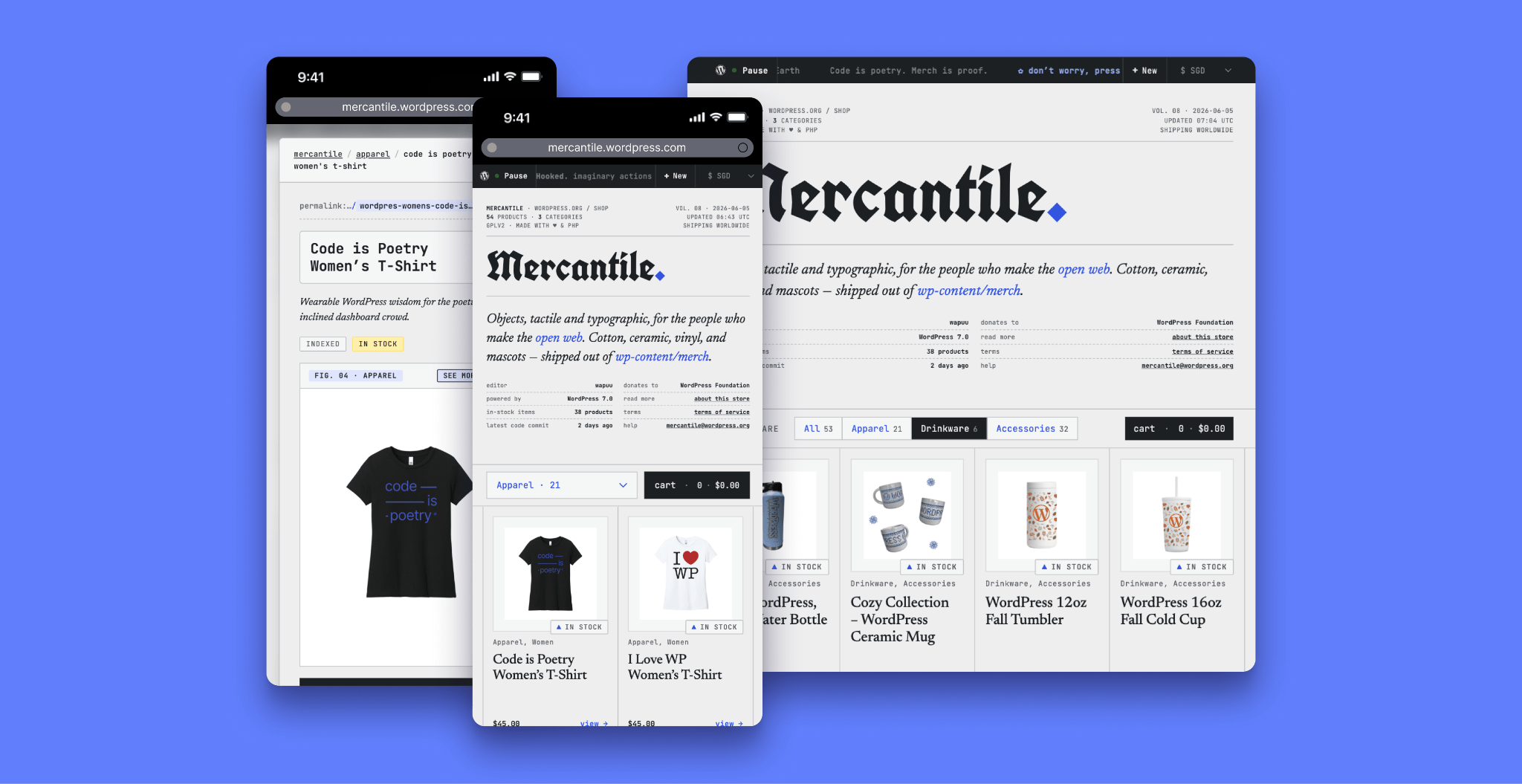
WordPress.org blog: Browse the New Mercantile Swag Store
Mercantile, the official swag store of the WordPress project, has a newly redesigned storefront with a catalog that now sits front and center, and a design tuned to hold up across a wide range of screen sizes. There are also small touches, like automatically selecting a variant when only one is in stock and order emails styled to match the look and feel of the store.

Throughout the design, the storefront leans into the history and culture of WordPress. Visual and copy choices nod to familiar elements of the project, from the metabox and the admin bar to Wapuu making the occasional appearance, with small open source and code references for those who look closely. The aim was a storefront that feels uniquely WordPress.
Under the hood, the storefront shows what a modern WordPress and WooCommerce site can do. It is built almost entirely with blocks, including a block-based cart, checkout, mini-cart, and order confirmation, supported by a set of custom theme blocks created for the store. The Interactivity API powers the catalog navigation and modal states, the store runs on WordPress 7.0, and accessibility is built in throughout, honoring reduced-motion preferences across animations and meeting color contrast standards. Product pages surface per-product attributes such as size, material, and care, so shoppers have the details they need before adding an item to the cart.

This latest redesign supported the Mercantile booth at WordCamp Europe. To make in-person sales work smoothly, the team enabled local pickup at checkout and added a set of event-only products refined to match the rest of the catalog. Fifty orders were completed at the event using in-person payments, a strong real-world test of the new checkout flow.
There is more on the way! A playful experiment in progress will let curious shoppers explore a text-based version of the store from the command line, a small tribute to the developers who make up much of the WordPress community. Subtle hints pointing the way will appear once it is ready.

The new Mercantile is the work of many contributors who designed, built, tested, and refined it together. Every purchase supports the WordPress Foundation, a 501(c)(3) nonprofit organization, in its mission to democratize publishing and preserve open source software for generations to come. Take a look around and find something you love.
-
Open Channels FM: Navigating Burnout in the Age of AI-Driven Development
AI transforms developer workflows, causing cognitive overload and blurring work-rest boundaries. Establishing intentional breaks is crucial to maintain balance and prevent burnout.
-
7 Best WordPress Code Snippets Plugins (I Tested Them All)
Every WordPress user eventually reaches a point where they need to add custom code to their site.
Whether you’re trying to install Google Analytics tracking code, add a small PHP function to tweak your theme, or just want some custom CSS to fix a stubborn layout issue, you need a reliable (and safe!) way to get that code onto your site.
Unfortunately, editing your theme’s functions.php file directly is incredibly risky.
One wrong character can immediately crash your entire site. Even if everything goes smoothly, you’ll lose all that code every single time you update your theme.
That’s exactly why I spent weeks testing every major code snippets plugin on the market. I wanted to find the ones that are actually worth installing, focusing on critical factors like built-in safety features, support for different code types, ease of use, and overall value.
In this guide, I’ll share my top picks so you can customize your site with total confidence.
Quick Summary: After testing all the top WordPress code snippets plugins, I recommend WPCode as the best overall choice. It combines a library of 3,000+ ready-to-use snippets, smart error handling, and flexible auto-insert locations into a single beginner-friendly plugin.
Quick Overview: 7 Best WordPress Code Snippets Plugins
# Plugin Best For Free Version Pricing 🥇 WPCode Best all-around code snippets plugin ✅ $49/yr 🥈 Code Snippets Best for beginners who want maximum safety ✅ $149/yr 🥉 Woody Code Snippets Best for marketers who also manage ads ✅ $39/yr 4 WPCodeBox Best for professional developers ❌ $39/yr 5 Header Footer Code Manager Best for simple tracking scripts ✅ $35/yr 6 Advanced Scripts Best for frontend developers who write SCSS ❌ $19.99 (lifetime) 7 Insert PHP Code Snippet Best for embedding PHP in posts and pages ✅ Free Why Use a Code Snippets Plugin?
If you’ve ever needed to add custom functionality to WordPress, you’ve probably been told to ‘just paste this snippet into your functions.php file.’
While this seems straightforward, it’s actually very risky. A single missing semicolon or a simple typo can take your entire WordPress website offline, leaving you with a broken site and a lot of stress.
Using a dedicated code snippets plugin solves this problem by storing your custom code in a completely separate database from your theme files.
This is a huge advantage because it means you won’t lose your customizations every time you update or change your WordPress theme.
Safety is another major reason to make the switch. Most high-quality code snippets plugins include built-in error detection that acts as a safety net.
This technology scans your code for mistakes and may even stop your code from running completely if it detects a potential crash. This means you can experiment with new features and site tweaks without fear.
Beyond safety, these plugins can also keep your site lean and fast. Many WordPress users fall into the trap of installing dozens of individual plugins just to handle minor tasks like disabling comments, adding a Google Analytics tracking script, or enabling SVG image uploads.
A single code snippets plugin can handle all these tasks using lightweight bits of code. This helps you avoid the performance bloat and potential software conflicts that come from having too many active plugins on your site.
For more on this topic, please see our article on WordPress plugin vs functions.php file (which is better?)
How I Tested and Reviewed WordPress Code Snippets Plugins
At WPBeginner, we know that adding custom code to your site can be nerve-wracking. One wrong line of code can easily break your site, which is why choosing the right tool is so important for your website’s performance and security.
To find the top solutions, I didn’t just look at the ratings. Instead, I put each code snippets plugin through a series of real-world stress tests to see which ones are truly reliable. My goal was to see how these plugins handle everything from simple CSS tweaks, right through to complex PHP functions.
Here’s the exact criteria I used when evaluating every plugin on this list:
- 🛠️ Installation and ease of setup: I looked at the onboarding process for each plugin. How quickly can you go from installing the plugin to successfully activating your first custom code snippet?
- 🔒 Safety and error handling: This is the most important test. I deliberately pasted broken code into each editor to see if the plugin would catch the syntax error or whether it would crash my entire site.
- 🔍 Code types supported: A great code snippets plugin should be a one-stop shop. With that in mind, I tested how well each tool handles different languages, including PHP, JavaScript, CSS, HTML, and even advanced preprocessors like SCSS (this is an advanced way to write CSS that saves developers time by using variables and shortcuts).
- ⚡ Performance impact: I used speed testing tools to measure the footprint of each plugin. I wanted to make sure the plugin didn’t add any noticeable overhead or slow down your page load times.
- 👍 Snippet management: As your site grows, organization becomes vital. I evaluated how easy it is to categorize, search, and toggle snippets on or off, and whether you can export snippets to a new project.
- 💰 Value for money: I compared the free versions against the premium offerings. In particular, I evaluated whether the free features are enough for most users and if the premium upgrades provide enough value to justify the cost.
I also tested a few other popular options like FluentSnippets and Simple Custom CSS and JS, but I left them off this list on purpose. My goal was to give you a focused set of clear picks for each type of user, rather than overwhelm you with every plugin I tried.
🙌 Why Trust WPBeginner?
At WPBeginner, our team has over 17 years of hands-on WordPress experience. We’ve tested thousands of plugins, themes, and tools on real websites. We also actively use WPCode on our own sites for custom code management.
We don’t just read feature lists. We install, configure, and test every product before recommending it. With 3,000+ tutorials and millions of readers every month, we take our recommendations seriously.
You can read more about our process in our editorial guidelines.
1. WPCode – Best All-Around Code Snippets Plugin
WPCode Pros ✅ Over 3,000 pre-built code snippets with one-click import
✅ AI snippet generation
✅ Advanced code revisions with a diff viewer and one-click rollback
✅ Snippet scheduling
✅ Smart error handling catches mistakes before they break your site
✅ Cloud snippet library lets you store, sync, and reuse custom code across multiple sites
✅ Supports PHP, JavaScript, CSS, HTML, and text snippets in a single plugin
✅ Admin bar code spotter shows exactly which snippets are active on any page you’re viewing
✅ Built-in code generators for custom post types, schema markup, and other common functionsWPCode Cons ❌ Conversion pixel tracking and WooCommerce integration require the Plus plan ($99/year) or higher
❌ AI snippet generation is capped by plan (the higher tiers raise the yearly limit, up to 500 on Pro and 1,000 on Bundle)Pricing Starts at $49/year (Free lite version also available) Best For WordPress users who want one plugin to handle all custom code needs with a massive pre-built snippet library WPCode is the most popular WordPress code snippets plugin on the market, with over 3 million active installations, and it’s the go-to choice for beginners and power users alike. It combines a massive pre-built snippet library and AI snippet generator with safe error handling and flexible placement options.
My Experience
In my opinion, WPCode’s snippet library is the standout feature, so it was the first thing I explored.
Instead of searching the web for code to disable Gutenberg on certain post types, I found a ready-made snippet right inside WPCode and added it with a single click.
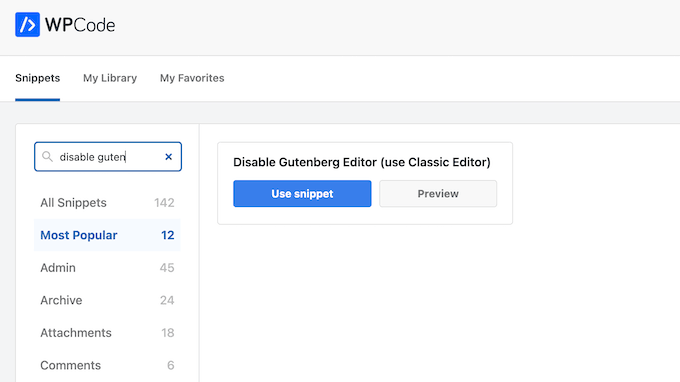
I also found snippets to add SVG upload support and remove the WordPress version number, so I completed three customizations in under two minutes without writing a single line of code.
When the library didn’t have exactly what I needed, I turned to WPCode’s AI snippet generation. I described what I wanted in plain English and WPCode wrote the PHP for me.
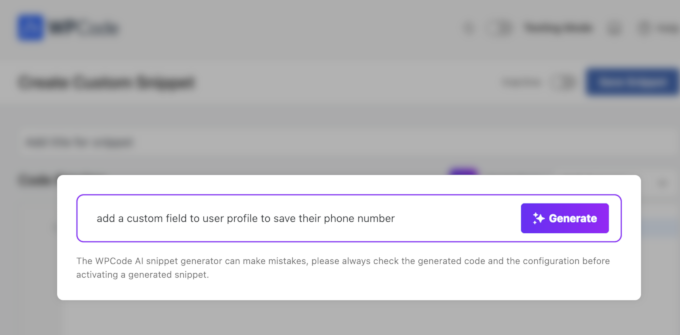
I then tested the auto-insert system, which is where WPCode really separates itself from simpler alternatives.
For this test, I added a custom message above the WooCommerce checkout form.
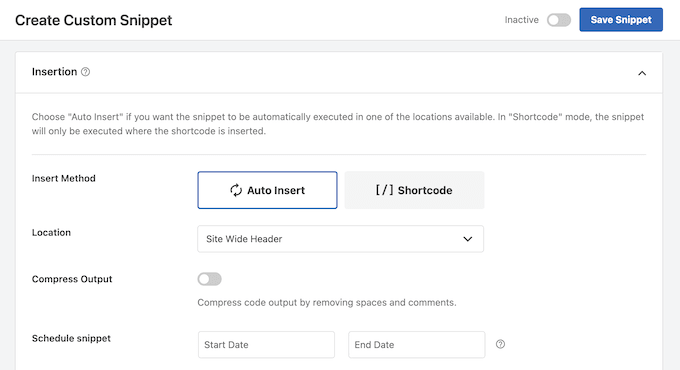
Instead of figuring out the correct WooCommerce hook myself, WPCode picked the right placement for me, and its auto-insert locations cover the header, footer, before and after post content, specific paragraphs, and WooCommerce-specific hooks.
I also explored WPCode’s conditional logic, which targets snippets by user role, page URL, post type, device type, and referral source without writing any PHP yourself.
I set up a snippet that only loads on mobile devices for logged-in users, and the whole process took about 30 seconds.
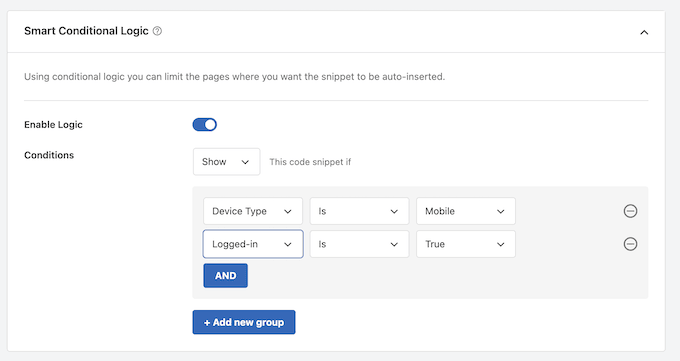
Snippet scheduling pairs nicely with this.
I set a start and end date and WPCode switched the snippet on and off automatically, with recurring schedules available for something like a seasonal banner.
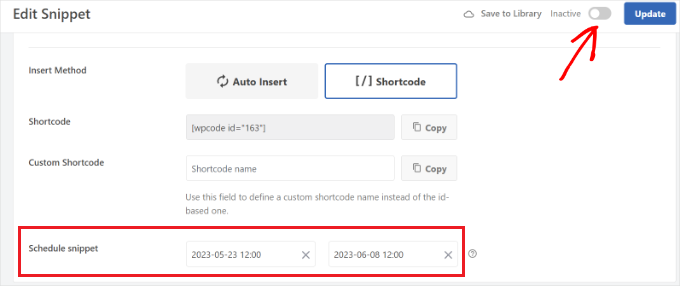
If you manage multiple sites, the cloud library is also genuinely useful. I saved a set of snippets to my private cloud account and pulled them into a second test site in a few clicks, which removes a ton of repetitive work for freelancers and agencies who reuse the same customizations across client projects.
Plus, advanced code revisions made editing over time feel safe. WPCode saves a version on every change, the diff viewer shows exactly what changed and who made the edit, and a one-click rollback restores the last working version, which is reassuring for teams handing sites to clients.
WPCode also includes code generators that build ready-to-use snippets for custom post types, schema markup, and other common functions from a simple form.
However, keep in mind that this is a very feature-rich and advanced plugin, so if you only need to paste a tracking script into your header, it may feel like overkill. In that case, a lighter option like Header Footer Code Manager further down this list makes more sense.
While there is a lite version of WPCode, it removes many of the best features. In particular, you’ll need to upgrade to the Plus plan ($99/year) or higher for conversion pixel tracking (Facebook, TikTok, Google) and WooCommerce integration.
🧑💻 Why I Recommend WPCode: WPCode is the best choice if you want a single plugin to handle all your custom coding needs. The pre-built snippet library alone makes it worth installing, and the paid plans start at $49/year with AI snippet generation, advanced code revisions, and snippet scheduling all included at that entry tier.
💡 For a deep dive into this popular code snippets plugin, check out our WPCode review.
2. Code Snippets – Best for Beginners Who Want Maximum Safety
Code Snippets Pros ✅ Safe Mode catches fatal PHP errors and disables the broken snippet before it takes down your site
✅ Interface mirrors the standard WordPress plugins page
✅ File-based execution mode bypasses database queries for better performance
✅ Built-in import tools let you migrate from WPCode, HFCM, or Insert PHP Code Snippet
✅ Free version works on unlimited sites with no limit on snippet countCode Snippets Cons ❌ CSS and JavaScript snippet support requires Pro starting at $149/year
❌ No built-in code generators or extensive pre-made snippet library
❌ Conditional logic for controlling where snippets run is locked behind the Pro planPricing Free for PHP snippets on unlimited sites. Pro starts at $149/year Best For Beginners who are nervous about adding custom code and want the strongest crash protection available Code Snippets is the second most popular code snippets plugin for WordPress, with over 1 million active installations. It’s built around one core principle: making it impossible for a code snippet to crash your site.
My Experience
Upon activation, the first thing I noticed was how familiar the Code Snippets interface felt.
The snippet management screen looks almost identical to the standard WordPress plugins page.
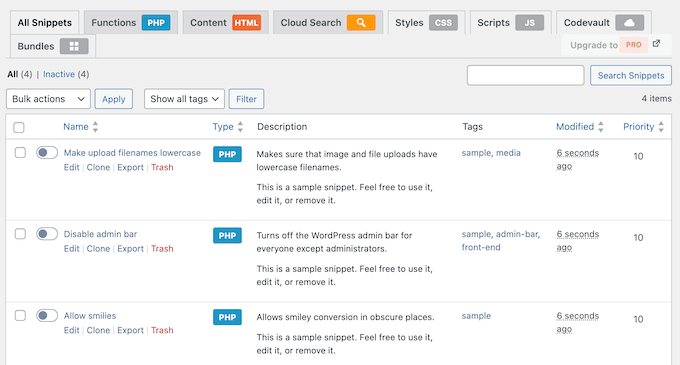
If you’ve ever activated or deactivated a WordPress plugin, then you already know how to use Code Snippets. That’s a smart design decision because it means there’s basically no learning curve for WordPress users.
I deliberately pasted a snippet with a syntax error to test the Safe Mode feature. Instead of crashing your site (often called the white screen of death), Code Snippets caught the fatal error, automatically disabled the problematic snippet, and displayed a clear error message explaining exactly what went wrong.
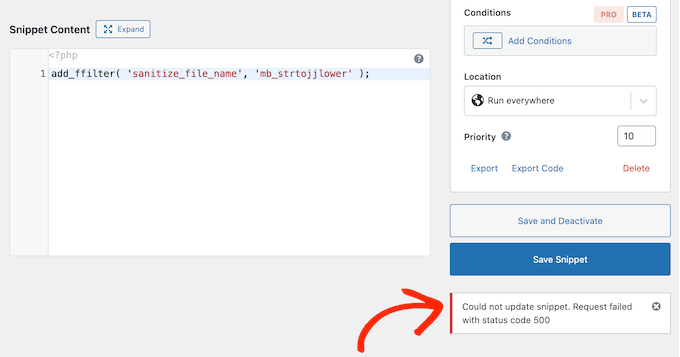
The error message even pinpointed the exact line where the problem occurred. This made it easy to identify and fix the issue.
I also tried the plugin’s file-based execution mode. Instead of loading snippets from the database on every page load, the plugin writes your snippets to the site’s file system.
This takes the heavy lifting off your website’s database, noticeably reducing the workload on your server and making your pages load faster for your visitors.
In addition, I was really impressed by the plugin’s import functionality.
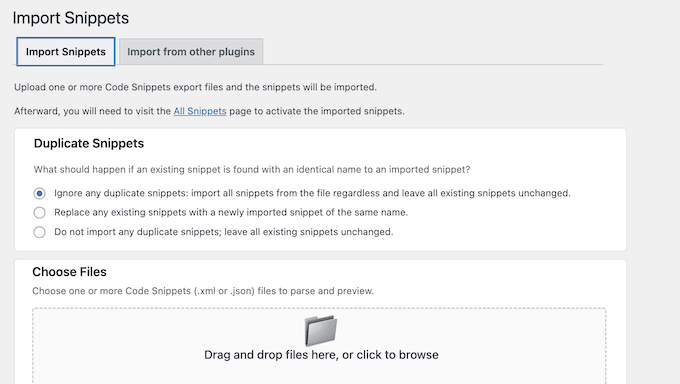
Code Snippets can import snippets directly from WPCode, Header Footer Code Manager, and Insert PHP Code Snippet. During testing, I exported a set of snippets from WPCode and imported them into Code Snippets with just a few clicks. If you ever need to switch plugins, this removes the biggest barrier to migration.
After that, I explored the Code Snippets Cloud platform, which is their community-driven snippet library. Here, you can search for common tweaks and download them directly into your site.
The Pro plan also adds AI-powered snippet generation, where you describe what you want in plain English and the plugin generates the necessary PHP code.
One limitation is that the free version of Code Snippets only supports PHP. If you need to manage CSS or JavaScript, then you’ll need to upgrade to the Pro plan (starting at $149/year).
This is a significant gap because WPCode Lite lets you manage all code types for free. The conditional logic builder is also locked behind the Pro plan, which means free users will need to handle page targeting manually in their PHP code.
🧑💻 Why I Recommend Code Snippets: This plugin is the best choice for beginners who are nervous about adding custom code to their sites. The Safe Mode feature is the most reliable crash protection I’ve tested, and the WordPress-native interface means there’s practically no learning curve for new users.
3. Woody Code Snippets – Best for Marketers Who Also Manage Ads
Woody Code Snippets Pros ✅ Dedicated ad snippet type lets you manage AdSense, affiliate banners, and promotional content alongside custom code
✅ Email error notifications alert you immediately when a snippet causes an issue
✅ Code revision history lets you roll back to a previous working version
✅ Lite version of Woody Code Snippets provides solid basic functionality for PHP, CSS, JS, and HTML snippets
✅ Execution priority management controls the order snippets run when multiple are activeWoody Code Snippets Cons ❌ Code revisions and rollback require the Personal plan ($39/year) or higher
❌ No pre-built snippet library. You’ll need to write all code from scratch or find it externallyPricing Free on WordPress.org. Premium plans start at $39/year Best For Bloggers and marketers who need to manage both custom code and ad placements from a single interface Woody Code Snippets is a hybrid code and content management plugin. What makes it unique is its built-in ad snippet type, which lets marketers manage AdSense placements, affiliate banners, and promotional blocks alongside their custom code.
My Experience
The ad snippet feature was the first thing I tested, since that’s what really sets Woody apart from other code managers.
Instead of installing a separate ad management plugin, I created ad snippets directly in Woody’s user interface.
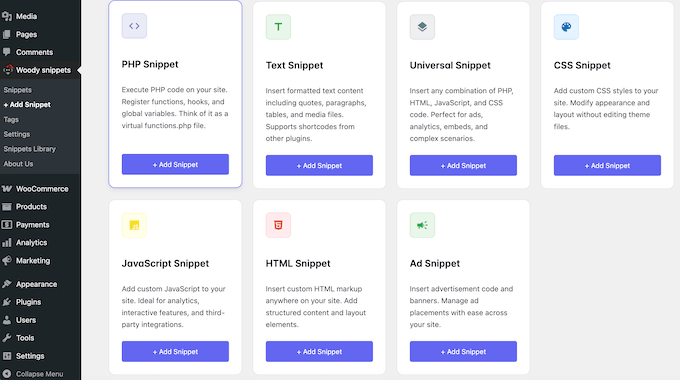
During testing, I set up different ad banners for different categories on a fictional personal finance blog. The finance category got investment-related ads, while the budgeting category got different promotions.
The conditional targeting made this whole process straightforward. If you’re currently adding Google AdSense manually, Woody provides a much cleaner approach. Just keep in mind that you will still need an active Google AdSense or affiliate network account to get the ad codes.
I also tested the standard code snippet types. Woody supports PHP, JavaScript, HTML, CSS, and ‘Universal’ snippets, which let you combine multiple code types in a single snippet.
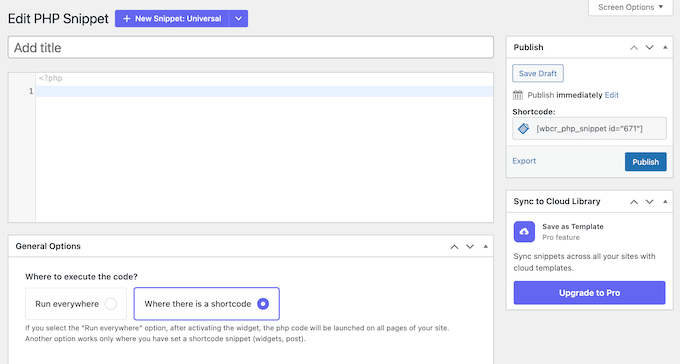
Woody’s email error notification feature was also genuinely useful. When I deliberately broke a PHP snippet during testing, the plugin sent me an email alert within seconds.
These notifications are invaluable when you manage multiple sites. Most competing plugins only show error messages in the admin panel itself, which are easy to miss when you’re juggling lots of different websites.
I also spent some time exploring the execution priority control. When you have multiple snippets active, you can assign a priority number to each one.
Setting the priority order took about two seconds and worked perfectly, every single time.
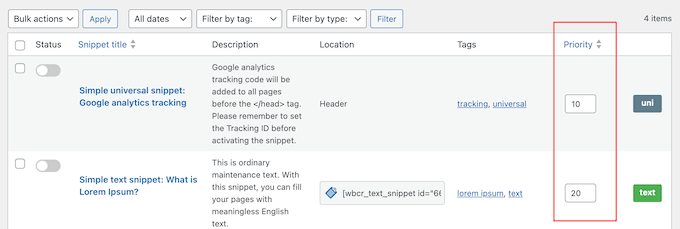
After that, I explored the code revision history in the premium plugin, which saves a version every time you edit a snippet. This is a life saver if you make a change that breaks something, and need to roll back quickly.
However, this feature requires a paid plan (starting at $39/year). Without this feature, there’s no easy way to undo a bad edit if it breaks your snippet.
Woody also doesn’t offer cloud sync or import tools for migrating from other snippet plugins. If you’re switching to Woody from WPCode, you’ll need to recreate your snippets manually.
🧑💻 Why I Recommend Woody Code Snippets: This is the best choice for bloggers and marketers who want to manage both custom code and ad placements from a single plugin. The dedicated ad snippet type saves you from installing yet another plugin, and the email notifications keep you informed without having to constantly check the dashboard.
4. WPCodeBox – Best for Professional Developers
WPCodeBox Pros ✅ Monaco editor gives you VS Code-level autocomplete, syntax highlighting, and documentation on hover inside WordPress
✅ SCSS and LESS compilation happens automatically, so you can use modern CSS workflows without a separate build tool
✅ Export snippets as standalone plugins that run independently from WPCodeBox
✅ Live reload for CSS changes gives you instant visual feedback
✅ cdnjs integration for loading external libraries without manual enqueueingWPCodeBox Cons ❌ No free version available, so you’ll need to pay $39/year to try it (although there’s a 30-day money-back guarantee)
❌ Cloud storage costs an additional $9 to $19 per month on top of the plugin license
❌ Professional developer interface is complex for beginnersPricing Starts at $39/year. Lifetime unlimited license available for $199 Best For Professional WordPress developers who want a full coding environment (IDE) inside the dashboard with SCSS compilation and cloud sync WPCodeBox brings a full integrated development environment (IDE) experience into the WordPress dashboard using the Monaco editor. This basically means you get a professional workspace for writing code.
What sets WPCodeBox apart is the editing environment itself. You get a full IDE inside WordPress, with autocomplete, documentation on hover as you type a hook name, and Emmet shortcuts.
On top of that, you can sync snippets across sites through the cloud and export any snippet as a standalone plugin that keeps running even if you turn WPCodeBox off. SCSS and LESS compilation are part of the package too, but the editing workflow is the real reason to pick it.
My Experience
The Monaco editor was the first thing that stood out when I opened WPCodeBox. WordPress autocomplete kicked in as soon as I started typing a hook name, showing me the correct parameters and linking to the official documentation on hover.
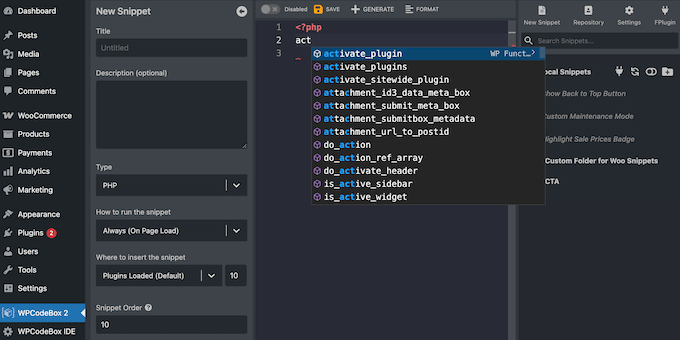
This is the kind of experience you normally only get in a desktop code editor like VS Code.
So, having it right inside the WordPress dashboard removes a lot of the context switching that slows down development work.
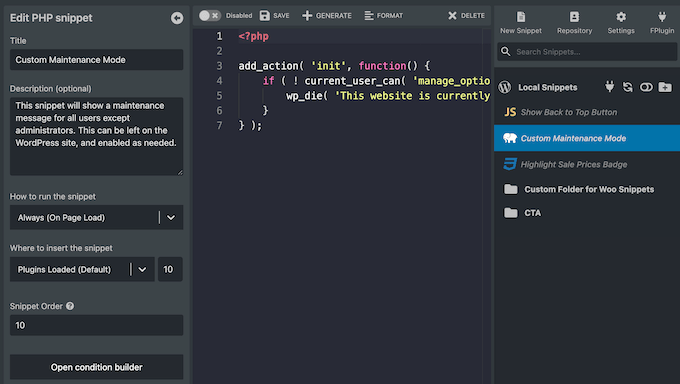
I tested the SCSS compilation by writing a set of partials with variables, nesting, and mixins. WPCodeBox compiled everything to clean, minified CSS automatically, with no build tools, npm, or command line. It supports LESS preprocessing the same way.
Live reload was another highlight. When I edited CSS properties in the WPCodeBox editor, the changes appeared on the front-end in real time without me needing to refresh the page.
You can also export snippets as standalone plugins. You select the snippets you want, WPCodeBox generates a fully independent WordPress plugin file, and your custom code keeps running even if you deactivate WPCodeBox. In my opinion, this is an invaluable safety net.
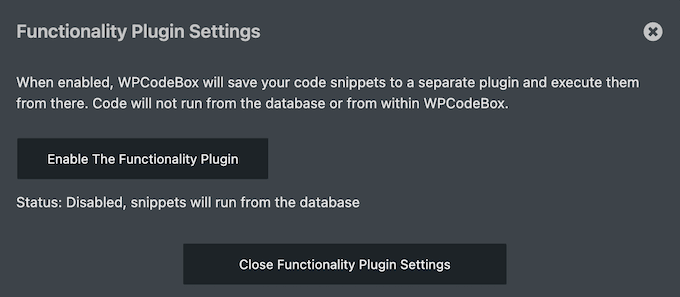
Beyond that, WPCodeBox’s condition builder lets you control exactly where and when each snippet runs. I set up conditions based on post type, user role, and specific page URLs, and while the interface is more complex than WPCode’s conditional logic, it offers finer-grained control that developers will appreciate.
The cloud sync works through API keys. During testing, I created different API keys for different clients so each one only had access to their own snippets, which is a useful security feature for WordPress agencies managing many sites. The catch is that cloud storage is an additional monthly cost ($9/month for 50 snippets or $19/month for unlimited) on top of the plugin license.
The trade-off is that there’s no free version. You’ll need to commit at least $39/year in order to try WPCodeBox, although there’s a 30-day money-back guarantee.
The professional developer interface is also not beginner-friendly. If you just need to paste a Google Analytics code into WordPress, this plugin is complete overkill.
🧑💻 Why I Recommend WPCodeBox: It’s the best choice for professional WordPress developers who want a full IDE inside their dashboard. The Monaco editor with autocomplete and docs on hover, cloud sync across sites, and the option to export snippets as standalone plugins make WPCodeBox the most powerful code management tool on this list.
5. Header Footer Code Manager – Best for Simple Tracking Scripts
Header Footer Code Manager Pros ✅ Simplest interface on this list for adding tracking scripts.
✅ User audit logging tracks who added or modified each snippet and when
✅ Device targeting lets you load scripts on mobile or desktop only
✅ Free version handles HTML, CSS, and JavaScript with full page-level targetingHeader Footer Code Manager Cons ❌ PHP code support requires the premium version ($35/year).
❌ No syntax highlighting, code editor, snippet library, or code generators
❌ No cloud sync or cross-site snippet managementPricing Lite version of HFCM available for free. Pro plans start at $35/year Best For Site owners who just need to add Google Analytics, Facebook Pixel, or other tracking scripts to specific pages Header Footer Code Manager is a lightweight plugin that makes it easy to add tracking scripts and code snippets to your header, footer, and content areas. With over 600,000 active installations, it’s one of the most popular choices for site owners who just need to paste in a tracking code.
My Experience
Setting up Header Footer Code Manager was refreshingly simple.
The plugin gives you a clean form where you name your snippet, choose the type (HTML, CSS, or JavaScript), pick where it should load, and select which pages it appears on. That’s the entire workflow.
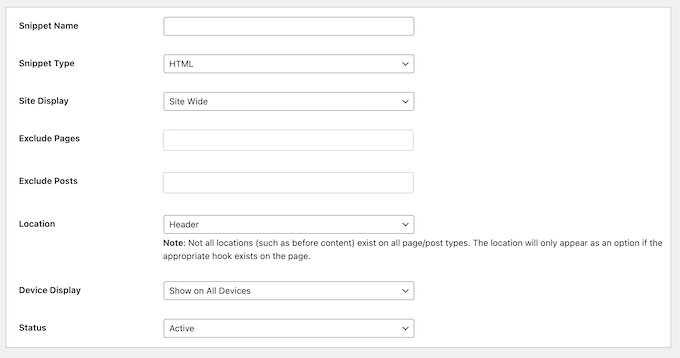
There’s no code editor, no conditional logic builder, and no complicated settings. For someone who just needs to paste a Google Analytics tracking code or a Facebook Pixel into their site’s header, this simplicity is perfect. I had a tracking script running on specific pages within about 60 seconds.
In addition, the page-level targeting options let you choose whether a snippet loads site-wide, on specific posts, specific pages, specific categories, specific tags, or specific custom post types. You can also exclude specific content from loading a snippet.
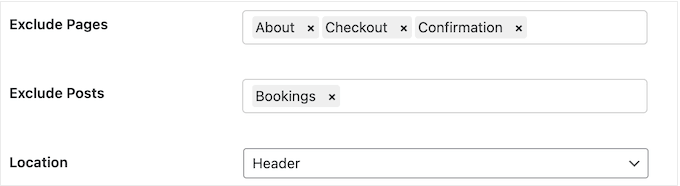
The device targeting feature was another practical touch. I configured a snippet to load only on mobile devices, which prevents unnecessary tracking scripts from slowing down the desktop experience. This is useful when you want to show your mobile and desktop audiences completely different campaigns.
One thing I really liked about Header Footer Code Manager is the user audit trail. You can see who created each snippet, who last edited it, and when.
For teams where multiple people manage the same site, this accountability is invaluable. You can quickly figure out who added a script that’s causing issues.
The plugin also supports shortcode output, so you can manually place a snippet anywhere in your content using a simple bit of code.
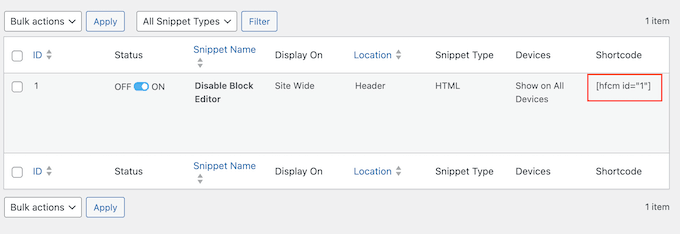
The shortcode approach is more flexible than the automatic placement options when you need pixel-perfect control. In fact, during testing I used this to insert a custom notification banner on a specific post.
I also tested the import and export functionality. I had no problems exporting all my snippets as a file, and then importing them to another site. This is useful for agencies who use the same tracking scripts across multiple client sites, although it’s not as smooth as WPCode’s cloud sync feature.
One frustrating limitation is that the free version doesn’t support PHP snippets. If you need to add custom WordPress functions, hooks, or filters, you’ll need to upgrade to the premium plan, which starts at $35/year.
The plugin also lacks syntax highlighting, which means you’re pasting code into a plain text box. For complex scripts, this makes debugging harder. There’s also no snippet library or code generators either.
Essentially, Header Footer Code Manager is purely a snippet management tool, rather than a development plugin.
🧑💻 Why I Recommend Header Footer Code Manager: This is the best choice if you just need to add tracking scripts, pixels, or simple HTML and CSS to specific pages. It does one job and does it extremely well, with the lightest footprint on this list.
6. Advanced Scripts – Best for Frontend Developers Who Write SCSS
Advanced Scripts Pros ✅ SCSS and LESS compilation outputs external minified CSS files
✅ All plans are lifetime licenses with no recurring fees.
✅ Safe Mode catches fatal PHP errors before they crash your site
✅ Zen mode editor provides a distraction-free, full-screen coding environment
✅ Oxygen Builder color palette integration syncs custom styles with global colorsAdvanced Scripts Cons ❌ No free version, although a 7-day trial is available
❌ Oxygen Builder integration has no value if you use a different page builderPricing $19.99 lifetime (single site). $39.99 lifetime (unlimited sites) Best For Front-end developers who write SCSS or LESS and want native compilation inside WordPress with lifetime pricing Advanced Scripts is a premium code management tool built for front-end developers who need native SCSS and LESS compilation inside WordPress. It takes a performance-first approach by compiling preprocessor code and generating external minified files for the best possible caching.
My Experience
The SCSS compilation was the first feature I tested. If you like using CSS variables and shortcuts to design your site faster, then this feature is the main reason you’d choose Advanced Scripts over the alternatives.
To do this, I wrote a set of SCSS partials with variables, nesting, and mixins.
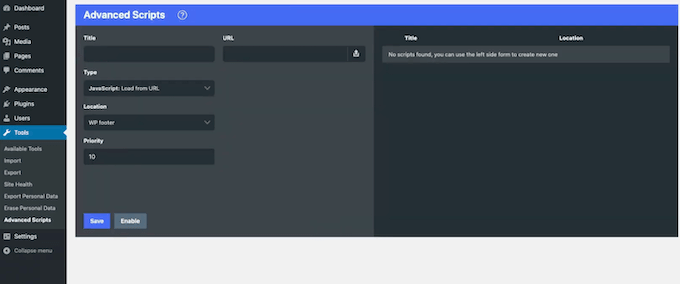
Advanced Scripts compiled everything into a single, minified external CSS file. The compiled CSS is served as a static file, which means browsers can cache it efficiently.
I also tested the LESS support, which works the same way. You write LESS code in the editor, and the plugin compiles it to CSS automatically. The SCSS Partials feature lets you organize your stylesheets into smaller files that get compiled together, which is a best practice for managing complex styling.
The Zen mode editor was a nice surprise during testing. It strips away all the WordPress dashboard navigation, sidebars, and toolbars, giving you a full-screen coding environment.
When you’re writing complex SCSS with multiple partials and variables, that distraction-free space genuinely helps you focus. I found myself preferring it over the regular admin view for longer coding sessions.
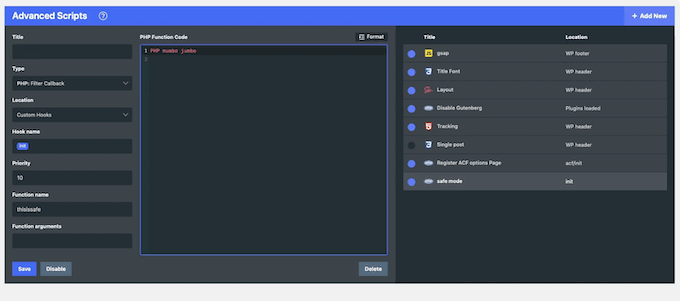
I also tested the conditional execution rules, which let you control which posts or pages load specific scripts.
To do this, I set up a SCSS snippet that only loads on WooCommerce product pages, keeping the styles isolated from the rest of my site. The condition builder is straightforward and covers the common targeting scenarios.
For Oxygen Builder users, the color palette integration is a standout feature. Your global Oxygen colors are available directly inside Advanced Scripts, and your custom SCSS updates automatically if you make any changes to the color palette.
However, this feature is completely irrelevant if you use Elementor, Beaver Builder, or any other page builder.
Going further, the CDN library integration lets you load web fonts and JavaScript libraries without having to register them manually. This allowed me to pull in a Google Font and a JavaScript library from the CDN with just a few clicks.
However, Advanced Scripts does have a smaller community. Plugins like WPCode have thousands of community-contributed snippets and extensive third-party tutorials.
By comparison, Advanced Scripts has very limited community content outside of the official documentation. As a result, you’ll almost certainly have to reach out to their support team if you run into an unusual issue.
🧑💻 Why I Recommend Advanced Scripts: Advanced Scripts is the best choice for front-end developers who write SCSS or LESS and want native compilation inside WordPress.
7. Insert PHP Code Snippet – Best for Embedding PHP in Posts and Pages
Insert PHP Code Snippet Pros ✅ Shortcode approach makes it the simplest way to embed dynamic PHP output directly in post content
✅ Multiple placement methods (automatic, on-demand, and shortcode)
✅ Free version covers the core PHP-to-shortcode functionality with no paid upgrade requiredInsert PHP Code Snippet Cons ❌ No conditional logic, auto-insert locations, or page-level targeting
❌ Interface is dated with no syntax highlighting or code editorPricing Lite version available from WordPress.org. There’s also a premium WP Insert Code Snippet plugin, made by the same developers. Best For Users who specifically need to run PHP code inside post or page content via shortcodes Insert PHP Code Snippet is a streamlined plugin that converts PHP code into WordPress shortcodes that you can place directly in posts, pages, and widgets. With over 90,000 active installations, it’s a popular plugin that’s often praised for its simplicity.
My Experience
Insert PHP Code Snippet is beautifully straightforward. Simply write your PHP code in the snippet editor, save it, and the plugin generates a shortcode.
Then, just paste that shortcode into any post, page, or widget where you want the PHP output to appear.
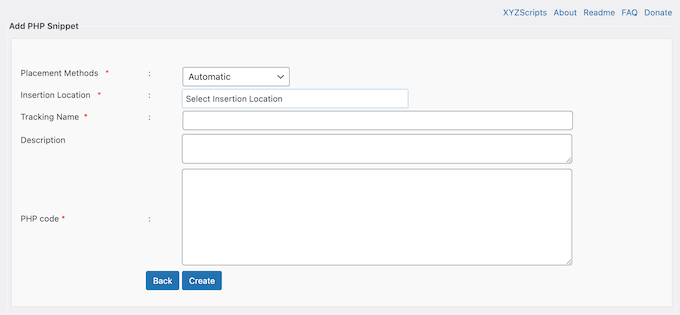
During testing, I created a snippet that queries a custom database table and displays a dynamic pricing table. I pasted the shortcode into a page, and the table rendered perfectly.
The TinyMCE dropdown is also a thoughtful touch. It lists all your snippets in a menu right inside the editor, so you never have to remember or type shortcode names.
While the dropdown is primarily designed for the Classic Editor, you can still insert your snippets via the block editor using the shortcode block. The plugin also added an ‘Execute shortcodes in editors’ setting so you can preview your custom PHP output live inside the Elementor page builder.
This plugin also recently added new placement methods. You can set snippets to run automatically on every page, execute on demand through a trigger, or use the traditional shortcode approach.
During testing, I used the automatic placement to add a site-wide disclaimer footer without editing any template files, and it worked perfectly.
I also tried the exception handling feature, which catches PHP errors within your snippets and sends you an email report. This isn’t as powerful as the safeguards in WPCode and other plugins, which prevent the error from affecting your site entirely. However, it still helps you identify when a snippet is causing problems.
The management screen shows all your snippets in a clean list with the shortcode displayed next to each one. You can activate, deactivate, edit, and delete snippets from this screen. It also supports bulk actions so you can manage multiple snippets at once.
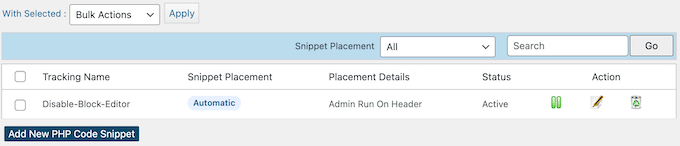
One clear limitation is that the free plugin only handles PHP. If you need to manage CSS, JavaScript, or HTML, you’ll need to upgrade to the premium version or use a different plugin entirely.
The interface is also dated compared to modern alternatives. There’s no syntax highlighting, no code autocomplete, and no error detection in the editor itself.
While this is fine for quick PHP snippets, for anything more complicated I recommend writing the code in a proper editor and then pasting it in.
There’s also no conditional logic or page-level targeting beyond the shortcode approach. If you want to run a snippet on specific pages, then you’ll need to place the shortcode on every single page manually.
Finally, just keep in mind that since this plugin executes PHP directly from your content editors, you should be careful if you allow guest authors or lower-level users to write posts on your site. You wouldn’t want unauthorized users accidentally (or intentionally) running custom PHP code.
🧑💻 Why I Recommend Insert PHP Code Snippet: This is a solid choice when you specifically need to run PHP code inside your post or page content. It’s the simplest solution for that particular use case, and the free version handles it perfectly.
What Is the Best WordPress Code Snippets Plugin?
Every website and project is unique, so the ‘best’ code snippets plugin for you will vary, depending on your specific needs. However, after testing the top options on the market, I’d recommend WPCode for most users.
For me, what sets WPCode apart is its Snippet Library, which features 3,000+ ready-to-use snippets covering everything from disabling comments, right through to adding Google Analytics. Instead of searching the web for code, you can find what you need right inside your WordPress dashboard or use WPCode’s powerful AI code generator.
If you don’t want to use WPCode, then there’s a few other options I’d recommend for specific use cases:
- If you’re worried about breaking your site, Code Snippets is the safest option. Its Safe Mode feature is the most reliable crash protection I’ve tested. It also uses a clean, familiar interface that looks just like the standard WordPress ‘Plugins’ page, making it very easy to manage, activate, and deactivate individual pieces of code.
- If you’re a marketer who also manages ads, Woody Code Snippets handles both custom code and AdSense placements from one interface. You can create a snippet for your ad code and use Woody to automatically place those ads at the beginning, middle, or end of your posts.
- If you’re a professional developer, WPCodeBox gives you a full IDE experience with the Monaco editor and SCSS compilation. It uses the same engine as VS Code, providing professional-grade auto-complete and syntax highlighting.
FAQs About WordPress Code Snippets Plugins
What is a code snippets plugin and why do I need one?
A code snippets plugin gives you a safe way to add custom code to your WordPress site without editing your theme’s functions.php file.
It stores your code separately from your WordPress theme, so you can update or even change your theme without losing your custom code. Most also include error detection that catches mistakes before they crash your site.
Will a code snippets plugin slow down my WordPress site?
Most modern code snippets plugins have minimal impact on your site’s performance. Some plugins like Code Snippets even offer file-based execution that bypasses database queries entirely.
Just be aware that the snippets themselves can affect speed if they contain inefficient code.
Can I use multiple code snippet plugins at the same time?
Technically yes, but it’s not recommended. Running multiple snippet plugins can lead to conflicts and debugging headaches.
Instead, I recommend picking the best plugin for you, and using it consistently.
What happens to my code snippets if I deactivate the plugin?
Typically, your custom code stops running straight away, but your snippets aren’t deleted. They stay in the database and you can restore them at any point, by reactivating your code snippets plugin.
WPCodeBox can also export snippets as standalone plugins that run independently.
Is it safe to add PHP code snippets as a beginner?
Yes, as long as you use a plugin with proper error handling. Both WPCode and Code Snippets catch fatal errors before they crash your site.
You can also enable WordPress debug mode to troubleshoot issues. That said, I still recommend testing new snippets on a staging site first, especially if you’re making significant changes.
Do code snippets plugins work with page builders like Elementor?
Yes, most code snippets plugins work alongside popular page builders without conflict. Insert PHP Code Snippet even added an ‘Execute shortcodes in editors’ option especially for Elementor.
What is the best free WordPress code snippets plugin?
WPCode Lite is the best free option because it supports PHP, JavaScript, CSS, HTML, and text snippets with no paid upgrade required.
Code Snippets is a close second if you only need PHP and want the strongest crash protection.
More Guides for Managing Custom Code in WordPress
- How to Disable XML-RPC in WordPress
- How to Disable REST API in WordPress
- How to Fix Fatal Error: Maximum Execution Time Exceeded
- How to Create a Site-Specific WordPress Plugin
If you liked this article, then please subscribe to our YouTube Channel for WordPress video tutorials. You can also find us on Twitter and Facebook.
The post 7 Best WordPress Code Snippets Plugins (I Tested Them All) first appeared on WPBeginner.